
Textbooks Were Wrong: 249-Million-Year-Old Fossil Discovery Upends Timeline of Evolution [View all]
By Swedish Museum of Natural History
November 25, 2025
5 Mins Read
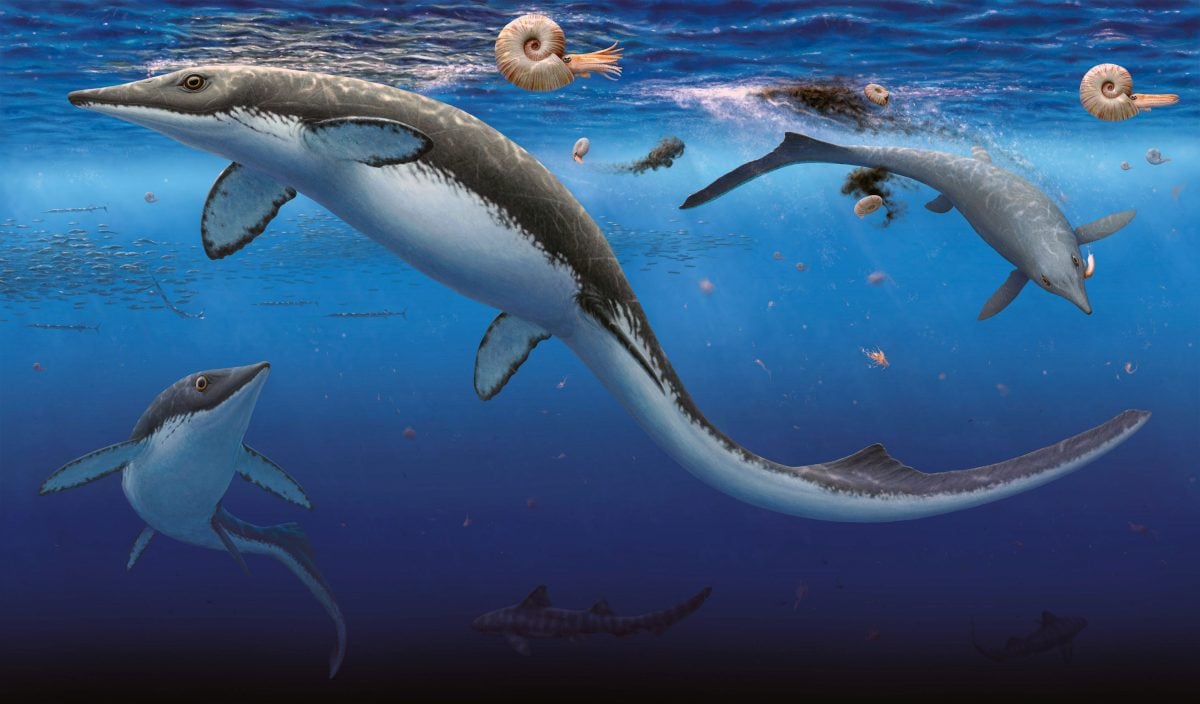
Earliest oceanic tetrapod ecosystem from 249 million years ago. A pod of the small-bodied ichthyopterygian (‘fish-lizard’) Grippia longirostris hunting squid-like ammonoids (center). A school of the bony fish Boreosomus and Saurichthys feed in the distance. Credit: Robert Back
Newly analyzed Arctic fossils show that marine ecosystems recovered astonishingly fast after the “great dying.”
More than 30,000 teeth, bones, and other fossil fragments from a 249-million-year-old marine ecosystem have been uncovered on the isolated Arctic island of Spitsbergen. The material comes from extinct marine reptiles, amphibians, bony fish, and sharks, and it captures the earliest known expansion of land-dwelling animals into ocean environments following a period of severe global warming and catastrophic extinction at the start of the Age of Dinosaurs.
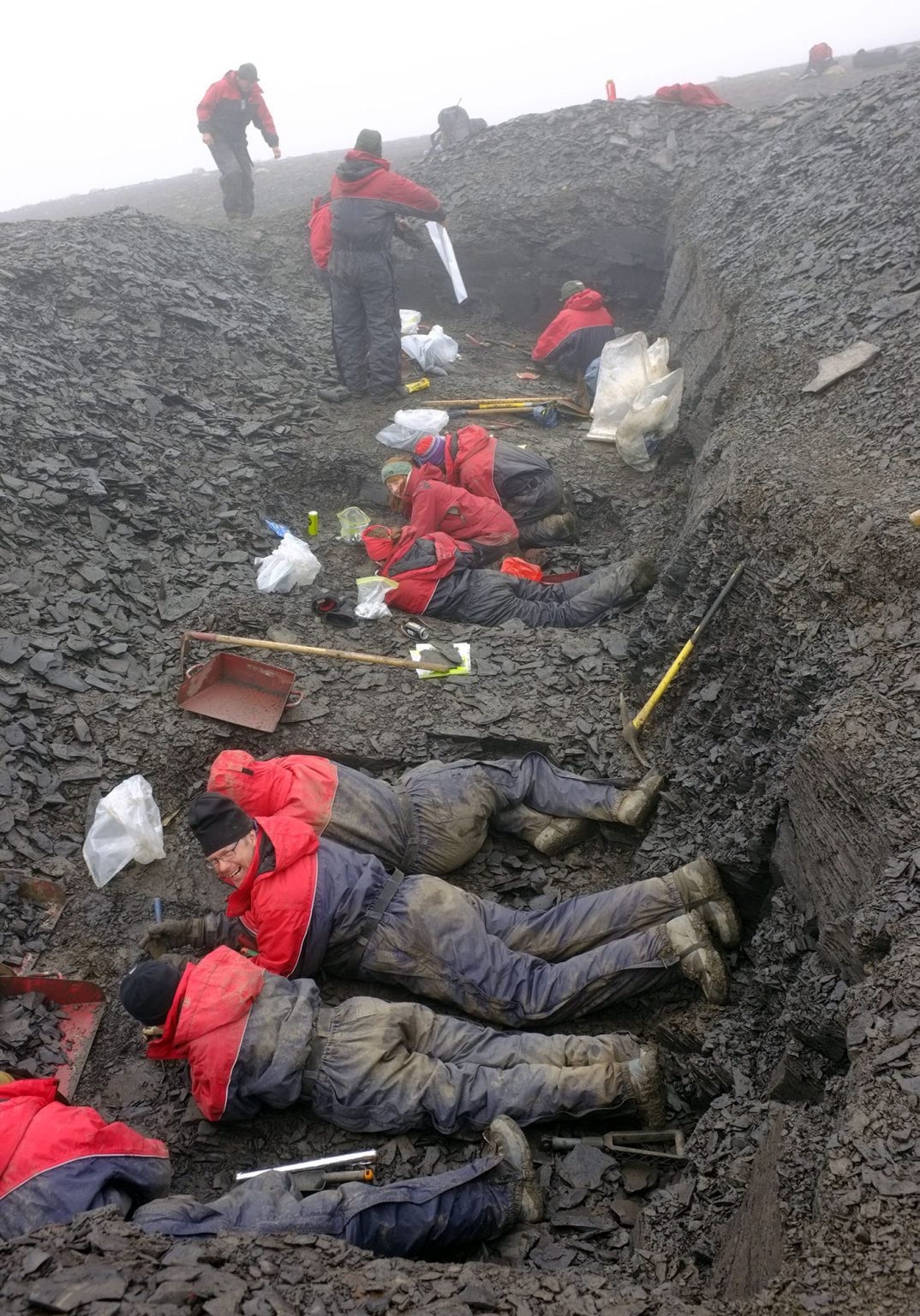
The fossils were originally located in 2015, but nearly ten years of detailed excavation, preparation, sorting, identification, and analysis were required before the results could be fully understood. A team of Scandinavian paleontologists from the Natural History Museum at the University of Oslo and the Swedish Museum of Natural History in Stockholm has now released the long-anticipated findings.
Spitsbergen, part of the Svalbard archipelago, is widely known for yielding marine fossils from the earliest stages of the Age of Dinosaurs. These remains are found within rock layers that were originally mud on the floor of a broad sea that extended through mid-to-high paleolatitudes and bordered the vast Panthalassa Super-ocean. Among the most striking finds are the unusual marine reptiles and amphibians that illustrate the first major adaptations of land animals to life in open-water environments.
After the “Great Dying”
According to standard scientific texts, this pivotal evolutionary shift occurred only after the most devastating mass extinction in Earth’s history about 252 million years ago. Known as the end-Permian mass extinction, this event, often referred to as the ‘great dying’, eliminated more than 90% of marine species. It was triggered by extreme greenhouse conditions, widespread ocean deoxygenation, and acidification that were tied to enormous volcanic eruptions marking the initial breakup of the ancient Pangaean supercontinent.
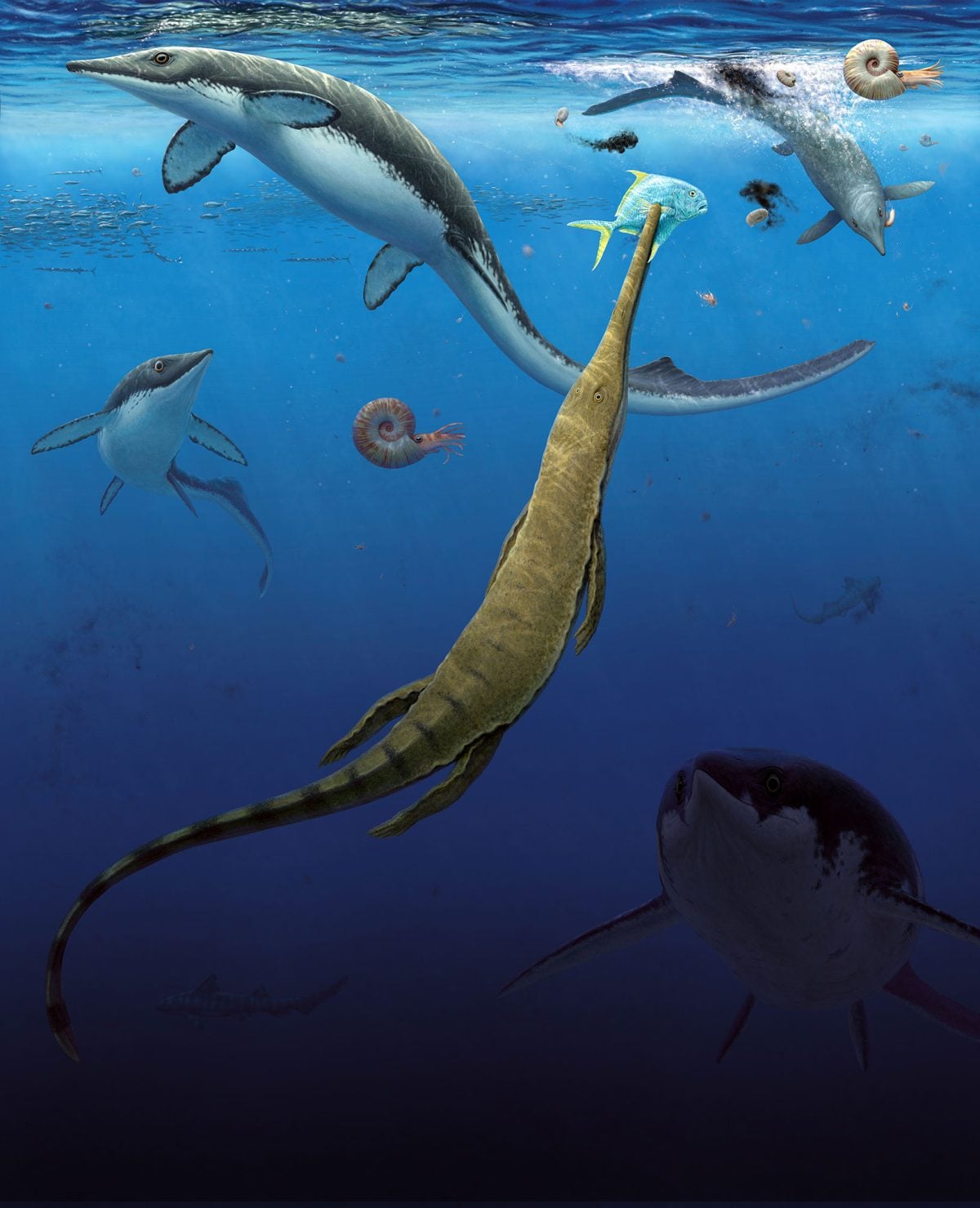
A pod of the small-bodied ichthyopterygian (‘fish-lizard’) Grippia longirostris hunting squid-like ammonoids (top left). The marine amphibian Aphaneramma captures the bony fish Bobastrania (foreground). The gigantic ichthyosaur Cymbospondylus lurks in the depths (bottom right). Credit: Robert Back
Timing the recovery of marine ecosystems after the end-Permian mass extinction is one of the most debated topics in paleontology today. The long-standing hypothesis is that this process was gradual, spanning some eight million years, and involved a step-wise evolutionary progression of amphibians and reptiles successively invading open marine environments. However, the discovery of the new and exceptionally rich fossil deposit on Spitsbergen has now upended this traditional view.
. . .
More:
https://scitechdaily.com/textbooks-were-wrong-249-million-year-old-fossil-discovery-upends-timeline-of-evolution/
(Don't the scientists have any self-respect????  )
)
 = new reply since forum marked as read
Highlight:
NoneDon't highlight anything
5 newestHighlight 5 most recent replies
= new reply since forum marked as read
Highlight:
NoneDon't highlight anything
5 newestHighlight 5 most recent replies