Science
Related: About this forumTextbooks Were Wrong: 249-Million-Year-Old Fossil Discovery Upends Timeline of Evolution
By Swedish Museum of Natural History
November 25, 2025
5 Mins Read
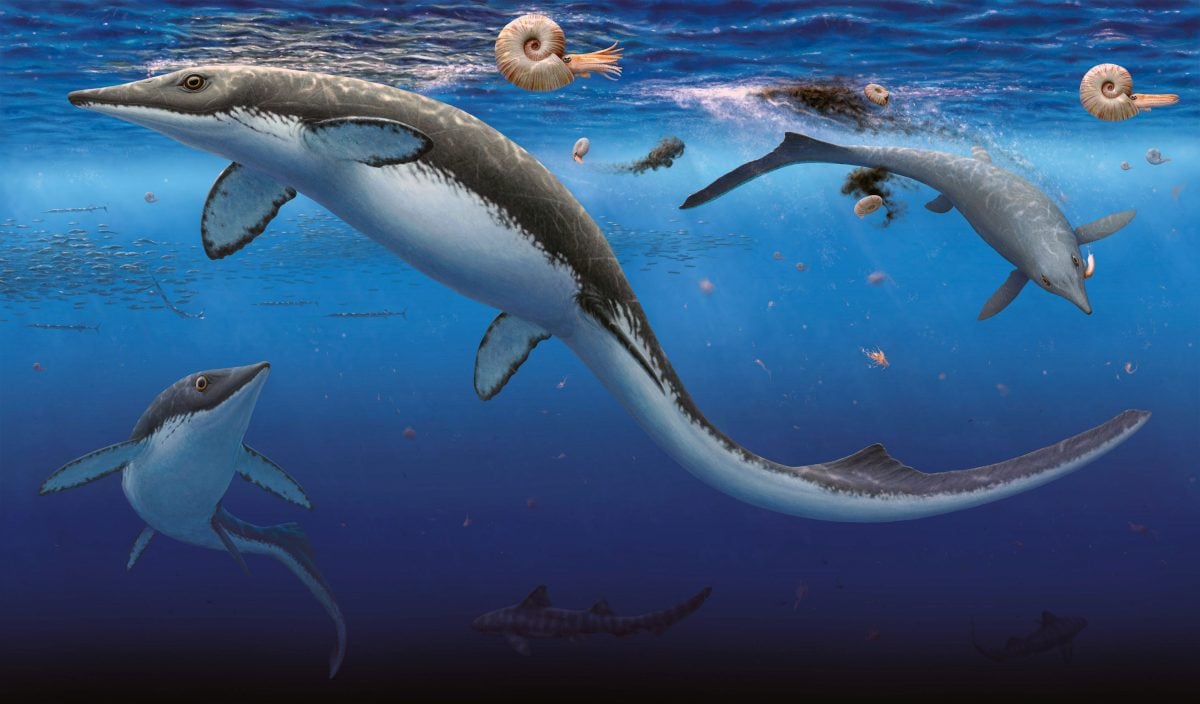
Earliest oceanic tetrapod ecosystem from 249 million years ago. A pod of the small-bodied ichthyopterygian (‘fish-lizard’) Grippia longirostris hunting squid-like ammonoids (center). A school of the bony fish Boreosomus and Saurichthys feed in the distance. Credit: Robert Back
Newly analyzed Arctic fossils show that marine ecosystems recovered astonishingly fast after the “great dying.”
More than 30,000 teeth, bones, and other fossil fragments from a 249-million-year-old marine ecosystem have been uncovered on the isolated Arctic island of Spitsbergen. The material comes from extinct marine reptiles, amphibians, bony fish, and sharks, and it captures the earliest known expansion of land-dwelling animals into ocean environments following a period of severe global warming and catastrophic extinction at the start of the Age of Dinosaurs.
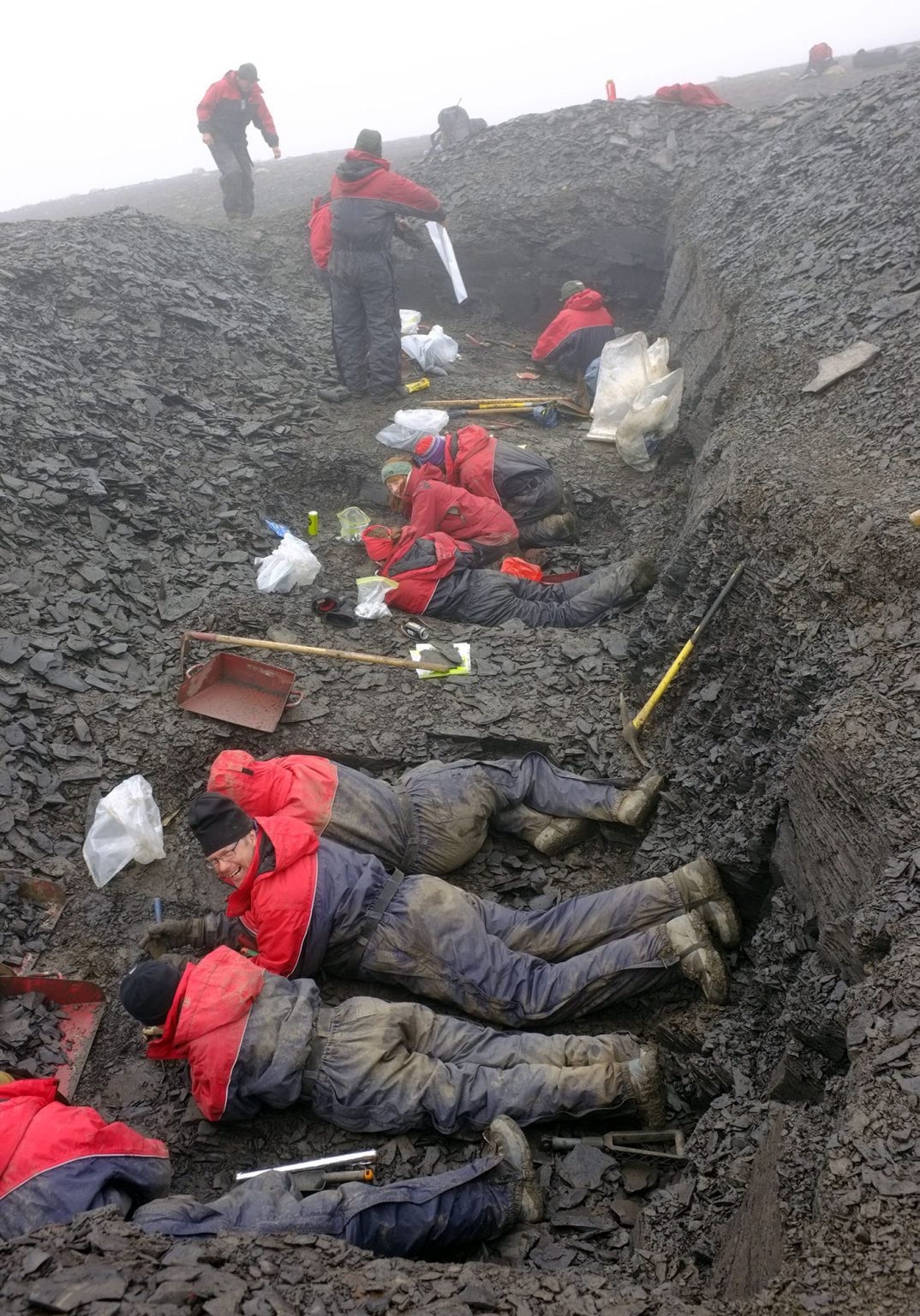
The fossils were originally located in 2015, but nearly ten years of detailed excavation, preparation, sorting, identification, and analysis were required before the results could be fully understood. A team of Scandinavian paleontologists from the Natural History Museum at the University of Oslo and the Swedish Museum of Natural History in Stockholm has now released the long-anticipated findings.
Spitsbergen, part of the Svalbard archipelago, is widely known for yielding marine fossils from the earliest stages of the Age of Dinosaurs. These remains are found within rock layers that were originally mud on the floor of a broad sea that extended through mid-to-high paleolatitudes and bordered the vast Panthalassa Super-ocean. Among the most striking finds are the unusual marine reptiles and amphibians that illustrate the first major adaptations of land animals to life in open-water environments.
After the “Great Dying”
According to standard scientific texts, this pivotal evolutionary shift occurred only after the most devastating mass extinction in Earth’s history about 252 million years ago. Known as the end-Permian mass extinction, this event, often referred to as the ‘great dying’, eliminated more than 90% of marine species. It was triggered by extreme greenhouse conditions, widespread ocean deoxygenation, and acidification that were tied to enormous volcanic eruptions marking the initial breakup of the ancient Pangaean supercontinent.
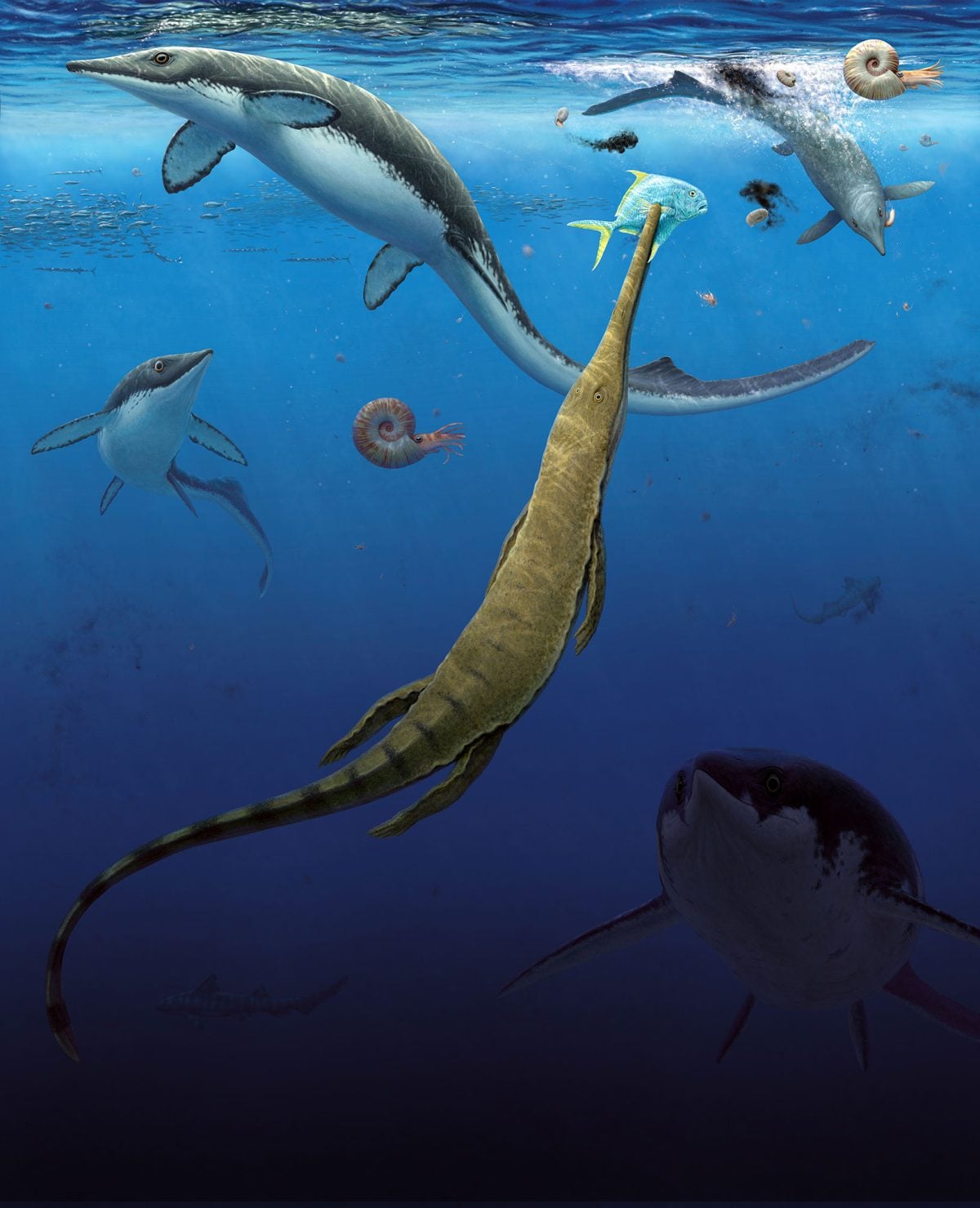
A pod of the small-bodied ichthyopterygian (‘fish-lizard’) Grippia longirostris hunting squid-like ammonoids (top left). The marine amphibian Aphaneramma captures the bony fish Bobastrania (foreground). The gigantic ichthyosaur Cymbospondylus lurks in the depths (bottom right). Credit: Robert Back
Timing the recovery of marine ecosystems after the end-Permian mass extinction is one of the most debated topics in paleontology today. The long-standing hypothesis is that this process was gradual, spanning some eight million years, and involved a step-wise evolutionary progression of amphibians and reptiles successively invading open marine environments. However, the discovery of the new and exceptionally rich fossil deposit on Spitsbergen has now upended this traditional view.
. . .
More:
https://scitechdaily.com/textbooks-were-wrong-249-million-year-old-fossil-discovery-upends-timeline-of-evolution/
(Don't the scientists have any self-respect????  )
)
 = new reply since forum marked as read
Highlight:
NoneDon't highlight anything
5 newestHighlight 5 most recent replies
= new reply since forum marked as read
Highlight:
NoneDon't highlight anything
5 newestHighlight 5 most recent replies

multigraincracker
(38,079 posts)With new information science can change to explain it.

erronis
(24,577 posts)
ancianita
(43,366 posts)Religions currently respect evolution's many paths as consistent with God's (the infinite God of the eternal now, outside time and space) ongoing creation.
When people don't know the history of religion (or philosophy of religion, as taught in most universities, originally founded by the Catholic church), they judge initial mistakes of religious leaders as the "fatal" flaw of religion at large. That's mere simplistic human ignorance.
The religious who take time to know ancient writings and the expansion of knowledge during and since the Roman empire, also know a few of these things:
Specific scientific fields
Physics:
Galileo Galilei, a devout Catholic until his death, was the father of observational astronomy, modern-era classical physics, the scientific method and modern science.
Josip Rudjer Boscovich, and Marin Mersenne (for acoustics) made foundational contributions.
Astronomy:
Nicolaus Copernicus, a devout Catholic until death, proposed the heliocentric model, while
Georges Lemaître, a Catholic priest, first proposed the Big Bang theory; Pope Pius XII later appointed him president of the Pontifical Academy of Sciences.
Biology:
Gregor Mendel, a Catholic monk, who laid the foundation of modern genetics; he's known as the father of genetics..
Louis Pasteur, devout Catholic who said that "Science brings man nearer to God"
was the major founder of bacteriology; he was a French chemist, pharmacist, and microbiologist renowned for his discoveries of the principles of vaccination, microbial fermentation, and pasteurization, among other scientific firsts
Geology: Nicolas Steno, Catholic priest and bishop, considered a founder of modern stratigraphy.
Chemistry: Antoine-Laurent de Lavoisier, devout Catholic until death, is credited with founding modern chemistry.
Medicine/Anatomy: Andreas Vesalius, devout Catholic work laid the groundwork for modern anatomy.
Besides the sciences, the first religion -- the Catholic Church in the early centuries during and after the Roman empire -- laid the foundations of art, music, architecture, cathedral schools which later became universities, all of which have given further training in all those areas of knowledge.

Kali
(56,911 posts)
ancianita
(43,366 posts)Jesus is quoted in Matthew 16:13-21
The Catholic Church, Jesus's 2,000 year old church, renamed Jesus Church as the universal church at the Council of Trent (catholic means "universal" in greek) just after the great schism was caused by the fallen priest, Martin Luther, who left to found his own version of christianity because of what he considered the sins of church leaders. Luther thought he -- 1,500 years after Jesus and his Apostles spread Jesus's church, and who became bishops of that church by 44 AD -- knew better than the 12 Apostles who actually lived with, heard, and recorded what Jesus actually said and taught them. Jesus repeats his Great Commission in Matthew 28:18-20, when he tells his Apostles to spread The Word. The disciples became Jesus's Apostles 50 days later, when the Holy Spirit descended upon them at Pentacost in the Upper Room. Acts 2 (or Luke-Acts, as it's often called.).
Then read Luke 10:1-23, to see what Jesus says about those who no longer follow the apostles teachings about Jesus (in the four gospels and the letters of Peter, James, John and Revelation).
Martin Luther threw out 6 books of the Hebrew Bible that Jesus considered scripture, which Jesus already knew inside and out. Luther also wanted to throw out the Epistle of James (who claimed that faith without works is dead, as did Paul in his letters) and Revelation, which Luther said "ought to at least reveal something."
Remember what Jesus said about his Apostles in Luke 10:16 --
"He who hears you hears Me, he who rejects you rejects Me, and he who rejects Me rejects Him who sent Me.”
The history of church founders...
Calvary chapel, 1965: Chuck Smith
Mormon church, 1830: Joseph Smith
Disciples of Christ, 1809: Thomas Campbell
Baptist church, 1609: John Smyth
Presbyterian church, 1560: John Knox
Calvinist church 1536: John Calvin
Lutheran church 1517: Martin Luther
Eastern-Orthodox church, 1054: Eastern Patriarchs
Catholic Church: 33: Jesus Christ
Kali
(56,911 posts)Catholicism certainly wasn't the first religion.

Bayard
(30,348 posts)Still has billions of followers today.
ancianita
(43,366 posts)a wide range of beliefs, including monotheistic, polytheistic, pantheistic, and atheistic views.
Hinduism also has a vast pantheon of deities often considered manifestations of a single supreme being called Brahman.
Hinduism has no single, universally agreed-upon holy book. Instead, followers refer to various sacred texts such as the Vedas, Upanishads, Puranas, and the Ramayana, three of which I had students read excerpts from in my World Lit. classes back in the day.
ancianita
(43,366 posts)5 He said to them, “But who do you say that I am?”
16 Simon Peter answered and said, “You are the Christ, the Son of the living God.”
17 Jesus answered and said to him, “Blessed are you, Simon Bar-Jonah, for flesh and blood has not revealed this to you, but My Father who is in heaven.
18 And I also say to you that you are Peter, and on this rock I will build My church, and the gates of Hell shall not prevail against it.
19 And I will give you the keys of the kingdom of heaven, and whatever you bind on earth will be bound in heaven, and whatever you loose on earth will be loosed in heaven.”
You either believe that Jesus established his church with Simon Peter or you don't.
Jesus's church is called the first of monotheistic, rational religions. As John Fugelsang, the Catholic, says...
" Jesus was:
A peaceful, radically nonviolent revolutionary
Who wasn't American and never spoke English
Who hung around lepers, hookers, and crooks
Never sought tax cuts for rich Nazarenes
Was anti-wealth and anti-death penalty
Anti-public prayer, too (Matthew 6:5)
Never asked lepers for a co-pay
Never called poor people "lazy"
Never even slightly antigay
Never mentioned abortion
Supported paying taxes
And was a long-haired
Community-organizing
Authority-questioning
Anti-slut-shaming
Brown skinned
Palestinian
Unarmed
Homeless
Jew
... but only if you believe what's actually in the Bible."
Kali
(56,911 posts)countless religions around before then.

Lovie777
(23,792 posts)Mankind will never exactly know a lot of aspects about evolution, that said, I do find it quite interesting reading.
Nevertheless, if I'm reading it correctly, it still confirms that life somewhat started from the waters.

NBachers
(19,588 posts)Easterncedar
(6,498 posts)They will be entertaining and enlightening me for a good while. Your generosity is one of the reasons I love DU.

NeoTrajan
(76 posts)That text books written 100 years ago can be expected to contain 'wrong information' today?
After all, with the many scientists working day in and day out, every day since that book was published, we would expect new facts to arise that overturn the beliefs of a century ago
So, no ... Nobody was 'lying to you' ... A scientist draws a line in the sand when they commit scientific beliefs to paper, which stands on the knowledge base of that day ... Further scientific investigations may or may not change facts in that knowledge base: That's how science works, and: It's nobody's fault
So, I question why scientists wouldn't have self respect ... Why wouldn't they respect themselves?
What did they do wrong?

Judi Lynn
(164,173 posts)