Crashing insect populations have resulted in smaller tree swallows that reproduce less [View all]
https://news.umich.edu/crashing-insect-populations-have-resulted-in-smaller-tree-swallows-that-reproduce-less/In bringing the role of biodiversity loss into better focus alongside climate change, researchers say that there may be opportunities to better protect wild birds
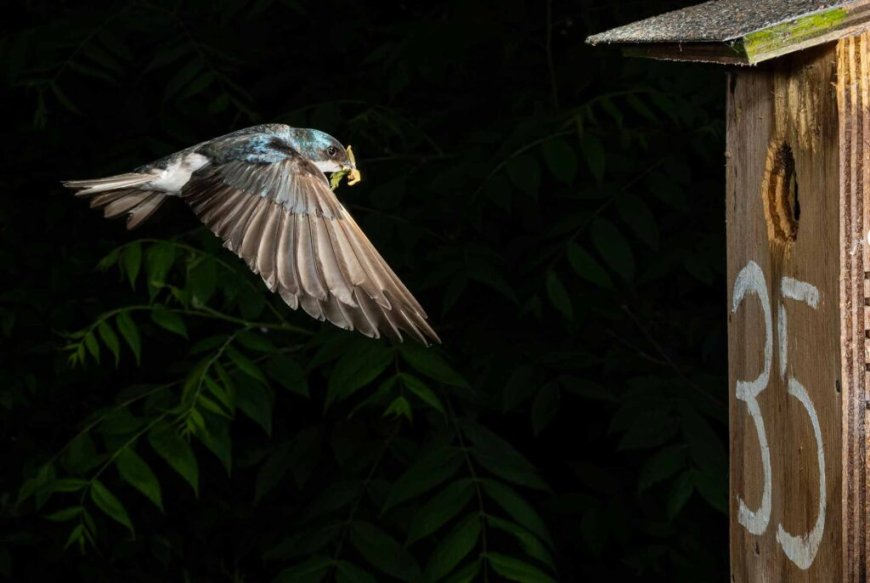 Tree swallows are uniquely suited for a study like this because they will return to nesting sites that researchers have set up for them. Researchers can also peek into nests to count eggs and band chicks without the parents abandoning the nest. Image credit: Sherri and Brock Fenton
June 25, 2026
Contact: Matt Davenport
Since the 1970s, the amount of insects at Canada’s Long Point Bird Observatory has dropped by more than 60%, according to a new study led by the University of Michigan. Because of this, today’s birds are smaller and facing greater challenges to their breeding success compared with previous generations.
The researchers focused on tree swallows, a rapidly declining bird species that feeds on flying insects.
“Tree swallow clutch size is really tightly tied to insect availability,” said
Charlotte Probst, lead author of the new study and a doctoral student in the U-M
School for Environment and Sustainability, or SEAS. “When there’s fewer insects available, the birds are smaller and the birds also produce fewer young.”
The study also integrates climate data, making it one of the first to consider the role of resource availability alongside climate change in understanding how these pressures are reshaping bird biology. The results show that climate impacts cannot be fully understood without considering biodiversity loss. In the case of tree swallows, finding ways to combat that loss outside of solving climate change could be reasons for cautious optimism, the team said.
…
C.M. Probst,S. Yanco,I. Clark,M. Ziebell,M. Fuirst,S.A. Mackenzie,I. Ibáñez, & B.C. Weeks, Resource declines shape phenological and morphological responses to climate change,
Proc. Natl. Acad. Sci. U.S.A. 123 (26) e2607714123,
https://doi.org/10.1073/pnas.2607714123 (2026).

 = new reply since forum marked as read