Welcome to DU!
The truly grassroots left-of-center political community where regular people, not algorithms, drive the discussions and set the standards.
Join the community:
Create a free account
Support DU (and get rid of ads!):
Become a Star Member
Latest Breaking News
Editorials & Other Articles
General Discussion
The DU Lounge
All Forums
Issue Forums
Culture Forums
Alliance Forums
Region Forums
Support Forums
Help & Search
Environment & Energy
In reply to the discussion: A floating solar plant using vertical panels is flipping the usual solar curve [View all]
OKIsItJustMe
(22,350 posts)8. "Dishonesty" you say?
Please note: Material below is drawn from a Creative Commons source:
IEA (2025), Renewables 2025, IEA, Paris https://www.iea.org/reports/renewables-2025, Licence: CC BY 4.0
Below, reference is made to a “Low-RES scenario”:
In the Low-RES scenario, electricity that was actually generated from wind and solar would instead have been produced using coal and natural gas. The modelling assumes that hydropower, nuclear and other non-renewable generation remain unchanged, and that additional fossil fuel demand would be met through imports, given the limited scope for scaling up domestic production in most importing countries.
(Begining on Page 80)
Renewables have helped countries reduce imports of coal by 700 million tonnes and natural gas by 400 billion cubic metres
From non-hydro renewable power generation capacity added between 2010 and 2023, approximately 3 200 TWh of electricity was generated in fuel-importing countries in 2023. Replacing this output with fossil fuels would require significantly higher energy inputs due to their lower conversion efficiencies. For example, typical coal and open-cycle gas turbine power plants operate at 30-40% efficiency, while combined-cycle gas turbines reach 50-60%. This means that each GWh of renewable electricity produced avoided the need for 2-3 GWh of fossil fuel inputs. For instance, 1 GW of solar PV capacity in Europe generates roughly 1 000 GWh annually, equivalent to burning around 3 000 GWh of coal, or approximately 400 000 tonnes.
As a result, global imports of coal and gas in 2023 would have been around 45% higher – equivalent to over 8 000 TWh of additional fuel inputs – without non-hydro renewable energy developments since 2010. This means roughly 700 million tonnes of coal and 400 billion cubic metres of natural gas, together representing about 10% of total global consumption of these fuels in 2023.
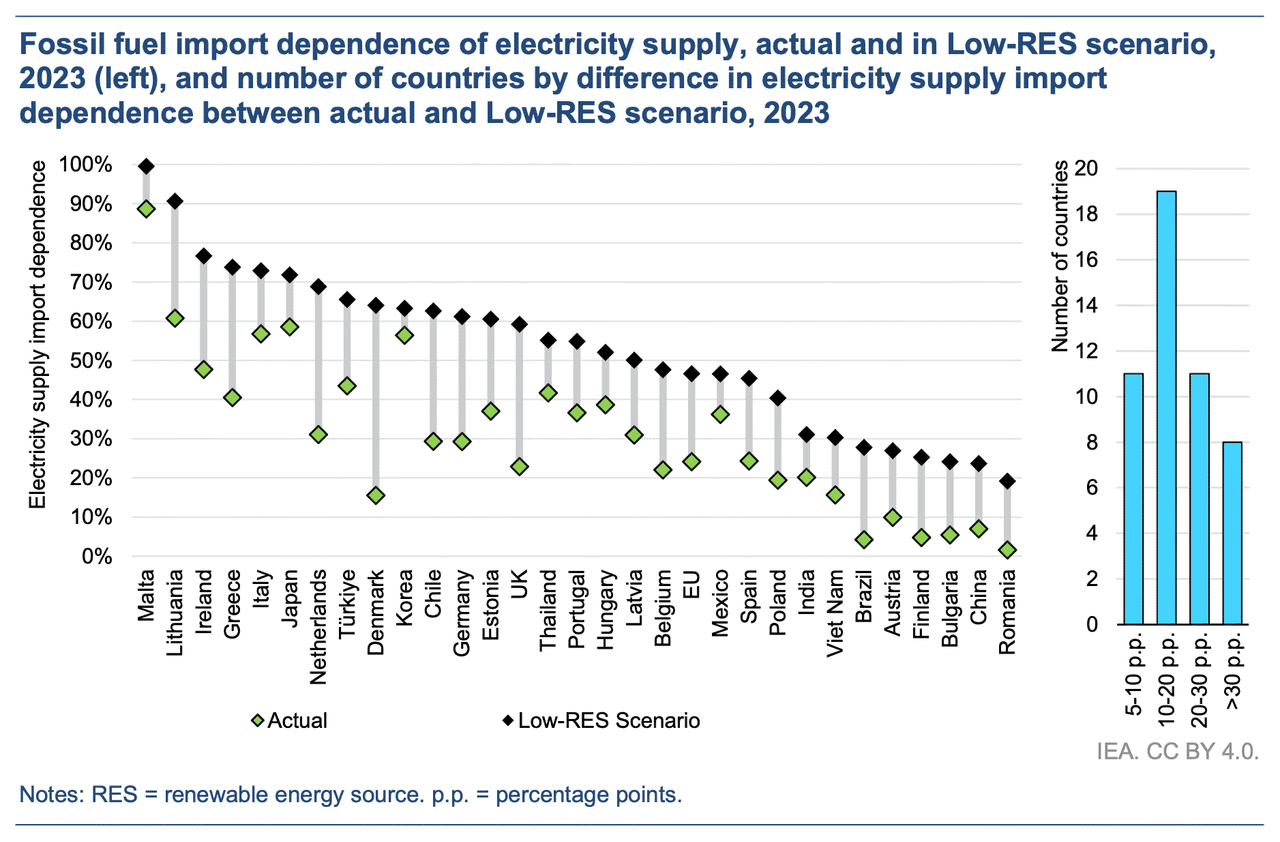
The Low-RES scenario results in a substantial increase in reliance on imported fuels for electricity generation, significantly raising energy security risks in many countries. This impact is especially pronounced in countries with limited domestic energy resources, where renewables have played a key role in avoiding high import dependence. In the absence of renewable energy deployment, countries such as Germany, Italy, the Netherlands, the United Kingdom, Denmark, Türkiye, Chile, Thailand and Japan would have greater fossil fuel-based generation, increasing their vulnerability to supply disruptions.
In the European Union, limited domestic fossil fuel resources have long been the main driver behind renewable energy incentives. In 2023, about one-quarter of the EU electricity supply was met by imported fossil fuels. Without wind, solar PV and bioenergy deployment over the previous decade, this share would have reached nearly 50%. The impact is most striking for Denmark, the Netherlands, Germany and Greece, where the difference could have been as much as 30-50 percentage points. In the Low-RES scenario, the energy security challenges during the 2022 energy crisis would have been significantly more severe.
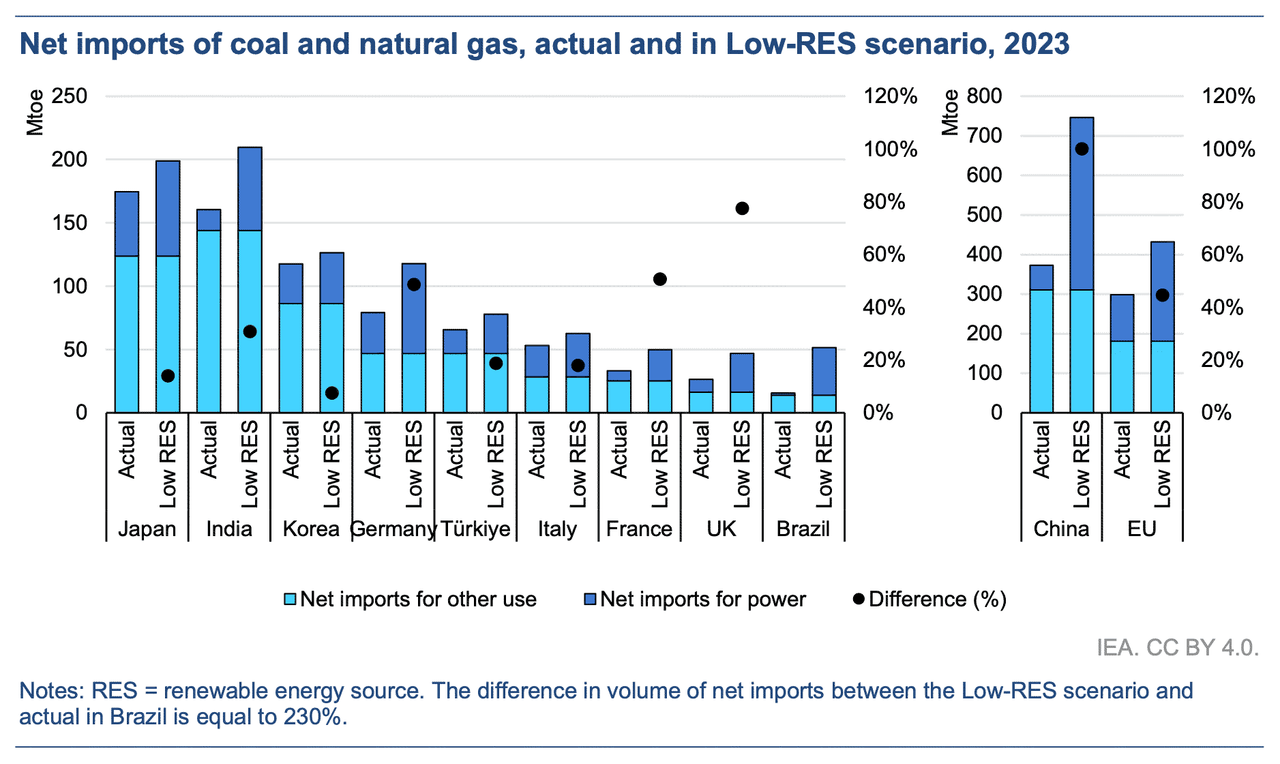
The United Kingdom expanded its non-hydro renewable electricity generation nearly sixfold between 2010 and 2023. As a result, the share of its electricity supply met by imported fossil fuels decreased from around 45% in 2013 to less than 25% in 2023, despite declining domestic coal and gas output. In the Low-RES scenario, import dependence would have approached 60% by 2023.
In China, despite massive domestic coal production, imports made up about 10% of the country’s total coal supply in 2023 – and nearly 40% of its natural gas. Without deployment of renewables over the past decade, China’ s fossil fuelbased electricity generation would have been more than 25% higher. This would have potentially required a doubling of fossil fuel imports, raising China’s electricity supply import dependence from 7% to nearly 25%.
Brazil, with one of the lowest fossil fuel import dependencies among large economies – around 5% in 2023 – would also have experienced significant impacts. Without wind and solar energy deployment, fossil-based generation would have needed to rise by around 170 TWh, primarily from imported natural gas. Imports of natural gas would have increased nearly five-fold, pushing electricity import dependence to almost 30%, despite the country’s large hydropower base.
…
From non-hydro renewable power generation capacity added between 2010 and 2023, approximately 3 200 TWh of electricity was generated in fuel-importing countries in 2023. Replacing this output with fossil fuels would require significantly higher energy inputs due to their lower conversion efficiencies. For example, typical coal and open-cycle gas turbine power plants operate at 30-40% efficiency, while combined-cycle gas turbines reach 50-60%. This means that each GWh of renewable electricity produced avoided the need for 2-3 GWh of fossil fuel inputs. For instance, 1 GW of solar PV capacity in Europe generates roughly 1 000 GWh annually, equivalent to burning around 3 000 GWh of coal, or approximately 400 000 tonnes.
As a result, global imports of coal and gas in 2023 would have been around 45% higher – equivalent to over 8 000 TWh of additional fuel inputs – without non-hydro renewable energy developments since 2010. This means roughly 700 million tonnes of coal and 400 billion cubic metres of natural gas, together representing about 10% of total global consumption of these fuels in 2023.
The Low-RES scenario results in a substantial increase in reliance on imported fuels for electricity generation, significantly raising energy security risks in many countries. This impact is especially pronounced in countries with limited domestic energy resources, where renewables have played a key role in avoiding high import dependence. In the absence of renewable energy deployment, countries such as Germany, Italy, the Netherlands, the United Kingdom, Denmark, Türkiye, Chile, Thailand and Japan would have greater fossil fuel-based generation, increasing their vulnerability to supply disruptions.
In the European Union, limited domestic fossil fuel resources have long been the main driver behind renewable energy incentives. In 2023, about one-quarter of the EU electricity supply was met by imported fossil fuels. Without wind, solar PV and bioenergy deployment over the previous decade, this share would have reached nearly 50%. The impact is most striking for Denmark, the Netherlands, Germany and Greece, where the difference could have been as much as 30-50 percentage points. In the Low-RES scenario, the energy security challenges during the 2022 energy crisis would have been significantly more severe.
The United Kingdom expanded its non-hydro renewable electricity generation nearly sixfold between 2010 and 2023. As a result, the share of its electricity supply met by imported fossil fuels decreased from around 45% in 2013 to less than 25% in 2023, despite declining domestic coal and gas output. In the Low-RES scenario, import dependence would have approached 60% by 2023.
In China, despite massive domestic coal production, imports made up about 10% of the country’s total coal supply in 2023 – and nearly 40% of its natural gas. Without deployment of renewables over the past decade, China’ s fossil fuelbased electricity generation would have been more than 25% higher. This would have potentially required a doubling of fossil fuel imports, raising China’s electricity supply import dependence from 7% to nearly 25%.
Brazil, with one of the lowest fossil fuel import dependencies among large economies – around 5% in 2023 – would also have experienced significant impacts. Without wind and solar energy deployment, fossil-based generation would have needed to rise by around 170 TWh, primarily from imported natural gas. Imports of natural gas would have increased nearly five-fold, pushing electricity import dependence to almost 30%, despite the country’s large hydropower base.
…
Edit history
Please sign in to view edit histories.
Recommendations
1 members have recommended this reply (displayed in chronological order):
11 replies
 = new reply since forum marked as read
Highlight:
NoneDon't highlight anything
5 newestHighlight 5 most recent replies
RecommendedHighlight replies with 5 or more recommendations
= new reply since forum marked as read
Highlight:
NoneDon't highlight anything
5 newestHighlight 5 most recent replies
RecommendedHighlight replies with 5 or more recommendations
= new reply since forum marked as read
Highlight:
NoneDon't highlight anything
5 newestHighlight 5 most recent replies
RecommendedHighlight replies with 5 or more recommendations
A floating solar plant using vertical panels is flipping the usual solar curve [View all]
usonian
Jun 5
OP
Guess what? "The performance and resilience of FPV systems during storms is another open area for research. "
usonian
Jun 5
#2
The obscenity of floating solar cells aside, it is not true that on most grids power peaks in the late afternoon.
NNadir
Jun 6
#4