Enshittification Isn't Limited to the Digital World [View all]

It’s also hardly a new phenomenon
https://thenoosphere.substack.com/p/enshittification-isnt-limited-to

First, it was the kettle that broke. Then the fridge started to malfunction. Then the vacuum cleaner. And finally, the grass trimmer. A couple of months ago, my partner and I found ourselves in the midst of an electronic appliances apocalypse of sorts. Perhaps you might just assume we got unlucky; the appliances stopped working all at once, after years of reliable service. Except that three of them — the kettle, fridge, and grass trimmer — had been bought
just a year earlier. All three were also from reputable brands, not the cheapest options, and vetted before purchase. Luckily, the fridge and grass trimmer were repairable. The vacuum cleaner, which, to be fair, was the oldest of the bunch, wasn’t. But the practically brand-new kettle was also declared beyond repair after spending a month awaiting its fate at the repair shop.
Sometimes I think to myself, unironically, that I should’ve started buying home appliances and furniture and clothing and other (supposedly) durable consumer goods when I was a teenager. I still own a few items from those days, which, at this point, I suspect I may even take to my grave. The ones I bought more recently? I doubt it. Everything’s supposed to be more convenient, more efficient, better now. Yet everything also seems worse. And there are a few reasons for that. Incandescent light bulbs were initially
designed to last as long as possible. The Centennial Light, first switched on in 1901 at a fire station in Livermore, California, still glows even today.
The business model was different back then, though. Customers, mostly wealthy individuals, purchased entire electrical systems, which were installed and maintained by their supplier. So, if a bulb burnt out, the cost of replacing it fell on the supplier. But as electrification spread and the market for light bulbs expanded, companies started selling them individually. Then, in December 1924, several major manufacturers, including Osram, General Electric, and Philips,
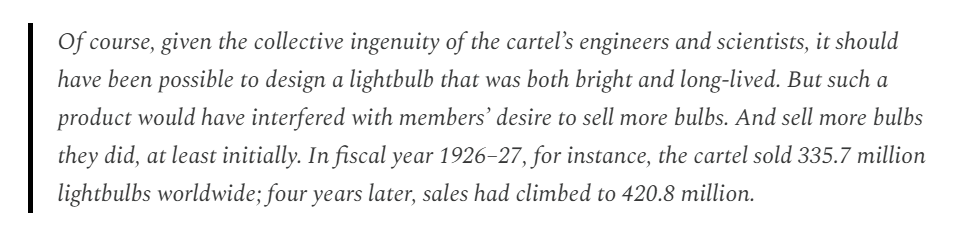
colluded to artificially reduce the lifespan of their light bulbs from around 2,500 hours to 1,000 hours.1 This plan, hatched by the international cartel also known as the Phoebus Cartel, is one of the earliest major cases of an industrial strategy that would
later be dubbed ‘planned obsolescence’ by the real-estate broker Bernard London. And its objective was, most likely, rather straightforward: sell more light bulbs. As media historian Markus Krajewski, who researched the Osram corporate archives in Berlin alongside journalist Helmut Höge,
notes:
In various forms, both subtle and overt, this strategy is still in use today. Apart from products being intentionally engineered to wear out faster (also referred to as contrived durability), other examples of product obsolescence include repairs being made difficult, uneconomic, or outright impossible (like batteries being
literally glued into devices or replacement parts being hard to find), software updates gradually rendering the product obsolete or slow (systemic obsolescence or
performance throttling), and intentional marketing of new products as superior and more desireable than previous ones (perceived obsolescence). These psychological tricks, artificial limitations, and declining durability—whether deliberate or the result of cheap, mass manufacturing and poor design—then keep us buying, replacing, upgrading, and throwing away far more than we probably should. And more than we
used to.
snip

 = new reply since forum marked as read