Seismic Mystery Solved: Scientists Find a New State of Matter at Earth's Center
By Science China Press
December 1, 2025
5 Mins Read
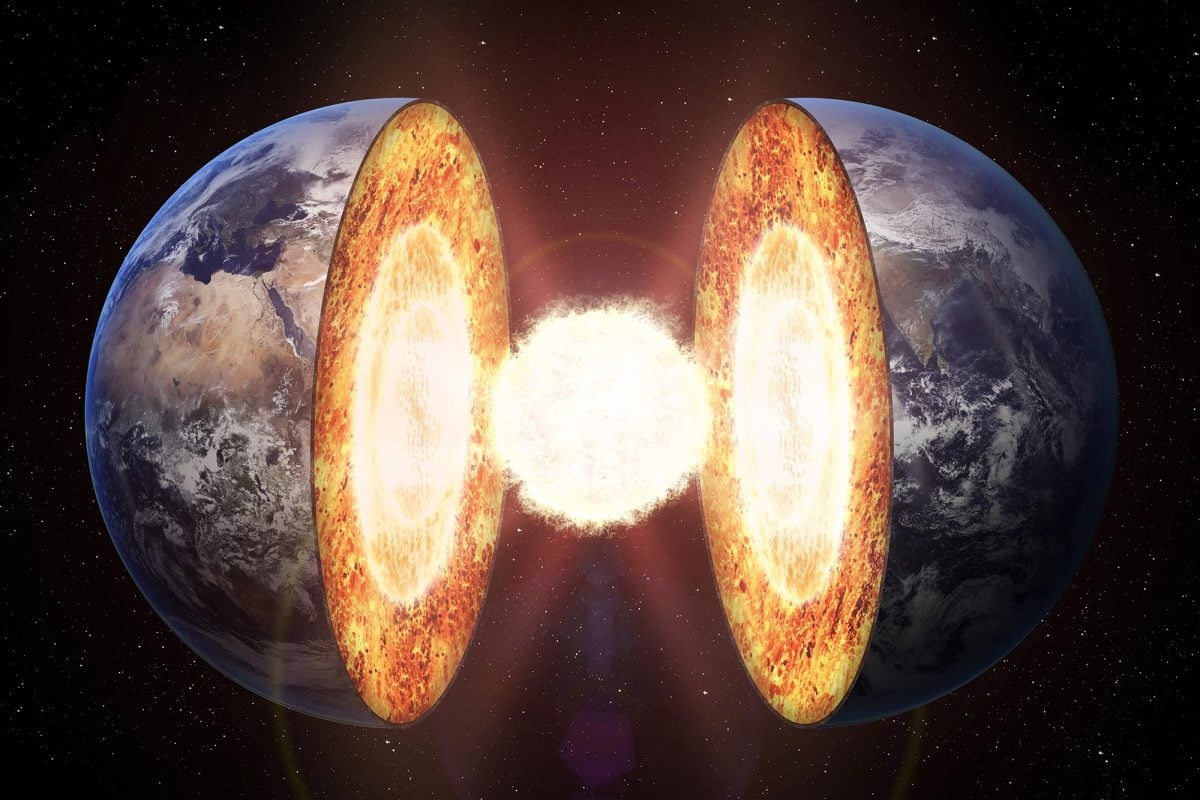
Earth’s inner core may not be a conventional solid at all, but a superionic material where light elements drift like liquid through a rigid iron lattice. New experiments show that this unusual state dramatically softens the core, matching seismic clues that have puzzled scientists for decades. Credit: Shutterstock
Chinese researchers have discovered that interstitial carbon in iron-carbon alloys behaves in a superionic, liquid-like state under Earth’s core pressure and temperature conditions.
Beneath Earth’s molten outer core lies a solid central region, the inner core, a compact sphere made of an iron light-element alloy pressed by more than 3.3 million atmospheres and heated to temperatures comparable to the Sun’s surface.
For many years, researchers have struggled to explain its unusual behavior: although it is solid, it behaves like an unexpectedly soft metal, slowing seismic shear waves and displaying a Poisson’s ratio closer to butter than to steel. This has raised a long-standing question about how the planet’s solid center can appear both firm and surprisingly pliable.
A major study published in National Science Review now provides a strong explanation. Scientists have found that Earth’s inner core is not behaving like an ordinary solid at all; instead, it occupies a superionic state, where light elements move through a rigid iron lattice with liquid-like mobility. This finding reshapes scientific views of what is happening deep within the planet.
More:
https://scitechdaily.com/seismic-mystery-solved-scientists-find-a-new-state-of-matter-at-earths-center/

 = new reply since forum marked as read
