Welcome to DU!
The truly grassroots left-of-center political community where regular people, not algorithms, drive the discussions and set the standards.
Join the community:
Create a free account
Support DU (and get rid of ads!):
Become a Star Member
Latest Breaking News
Editorials & Other Articles
General Discussion
The DU Lounge
All Forums
Issue Forums
Culture Forums
Alliance Forums
Region Forums
Support Forums
Help & Search
American History
Related: About this forum
On November 15, 1942, six Boston firefighters were killed in the Great Luongo Fire, aka the Maverick Square Fire.
Big hat tip to Coldwater for pointing out this fire.
Wed Dec 3, 2025: Living Here in Massachusetts
East Boston History > History > Local History
Notes on the Great Luongo Fire of 1942
By admin - January 16, 2021
by Michael Laurano
Notes on the Great Luongo Fire of 1942
November 15, 1942
We Remember: That cold wind swept wartime Sunday morning November 15,1942 is forever etched in memory as the day of the “Luongo Fire”. So called because a café and restaurant of that name then occupied the site of a horrific disaster that occurred at the corner of Henry Street and Maverick Square, East Boston.
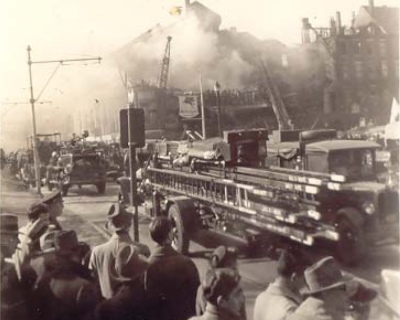
1942-GreatLuongoFIREMaverickEastBoston
Photo courtesy of Michael Laurano Estate
A kitchen grease fire had first flared in the early morning hours. A few hours later the fire seemed to be under control. Then a brick wall suddenly collapsed and the scene erupted into a devastating inferno. The conflagration claimed the lives of six Boston firefighters trapped inside by the collapse with several dozen more firefighters injured, some permanently. It fast became a day of heart wrenching tragedy most devastating for the inconsolable loss of human life. The ultimate sacrifice of those six men we still do and always will mourn. It was also a day of witness to stirring courage and valiant bravery as firefighters attempted rescue of their trapped comrades.
It was a day of faith too. Clergy entered the still dangerous ruins extending the comforts of faith to those trapped there. As word of the disaster spread by radio, telephone and telegraph wire — then our only means of instant communication — soon at the horrific scene also were multitudes of other responders civilian and military. Coast Guardsmen, Police, ambulance drivers, medical and other support personnel, and newspaper reporters too each played a part by their devotion to duty in East Boston’s epically tragic story of the “Luongo Fire.”
Words must fall short. We remember them all in silent tribute.
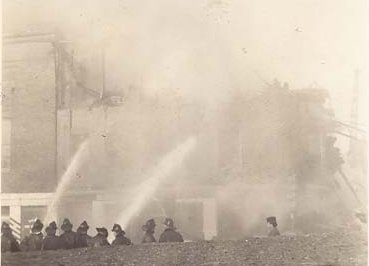
Corner of Henry Street and Maverick Square @ 1910
Historical Note: Three and a half story high, with granite faced and brick exterior walls, the interior wooden joisted building at the corner of Henry Street and Maverick Square in 1942 was one of the oldest buildings in East Boston. It was typical of mid 19th century Boston commercial construction. In accounts of the fire it is frequently referred to as “Old Armory Hall”. “Armory Hall” is the name by which it was known in the early years of the 20th century. That building however never was actually an armory as such. There once was an armory in East Boston. It was located at the corner of Maverick and Bremen Streets in a wooden building that preceded the still standing brick Overseers of the Public Welfare Building. The building in which the “Luongo Fire” occurred was built sometime before 1858. It was known originally as “Ritchie Hall” likely from the name of its owner.
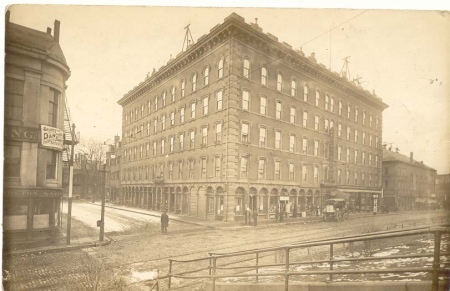
1942-GreatLuongoFIREMaverickEastBoston2
Corner of Henry Street and Maverick Square @ 1910
{snip}
Originally posted January 16, 2021
Notes on the Great Luongo Fire of 1942
By admin - January 16, 2021
by Michael Laurano
Notes on the Great Luongo Fire of 1942
November 15, 1942
We Remember: That cold wind swept wartime Sunday morning November 15,1942 is forever etched in memory as the day of the “Luongo Fire”. So called because a café and restaurant of that name then occupied the site of a horrific disaster that occurred at the corner of Henry Street and Maverick Square, East Boston.
1942-GreatLuongoFIREMaverickEastBoston
Photo courtesy of Michael Laurano Estate
A kitchen grease fire had first flared in the early morning hours. A few hours later the fire seemed to be under control. Then a brick wall suddenly collapsed and the scene erupted into a devastating inferno. The conflagration claimed the lives of six Boston firefighters trapped inside by the collapse with several dozen more firefighters injured, some permanently. It fast became a day of heart wrenching tragedy most devastating for the inconsolable loss of human life. The ultimate sacrifice of those six men we still do and always will mourn. It was also a day of witness to stirring courage and valiant bravery as firefighters attempted rescue of their trapped comrades.
It was a day of faith too. Clergy entered the still dangerous ruins extending the comforts of faith to those trapped there. As word of the disaster spread by radio, telephone and telegraph wire — then our only means of instant communication — soon at the horrific scene also were multitudes of other responders civilian and military. Coast Guardsmen, Police, ambulance drivers, medical and other support personnel, and newspaper reporters too each played a part by their devotion to duty in East Boston’s epically tragic story of the “Luongo Fire.”
Words must fall short. We remember them all in silent tribute.
Corner of Henry Street and Maverick Square @ 1910
Historical Note: Three and a half story high, with granite faced and brick exterior walls, the interior wooden joisted building at the corner of Henry Street and Maverick Square in 1942 was one of the oldest buildings in East Boston. It was typical of mid 19th century Boston commercial construction. In accounts of the fire it is frequently referred to as “Old Armory Hall”. “Armory Hall” is the name by which it was known in the early years of the 20th century. That building however never was actually an armory as such. There once was an armory in East Boston. It was located at the corner of Maverick and Bremen Streets in a wooden building that preceded the still standing brick Overseers of the Public Welfare Building. The building in which the “Luongo Fire” occurred was built sometime before 1858. It was known originally as “Ritchie Hall” likely from the name of its owner.
1942-GreatLuongoFIREMaverickEastBoston2
Corner of Henry Street and Maverick Square @ 1910
{snip}
Originally posted January 16, 2021
Memorial Monday — Remembering Boston’s Maverick Square Fire
Six Boston firefighters die in the deadliest fire since 1898’s Merrimac Street tragedy
NFFF NOVEMBER 25, 2024 12:01 AM
INCIDENT DATE: November 15, 1942
DEPARTMENT: Boston Fire Department (MA)
NUMBER OF LINE-OF-DUTY DEATHS: 6
Long before dawn on the blustery, 12-degree morning of Sunday, November 15, 1942, a fire broke out that would leave a lasting impact on both the East Boston neighborhood—and the entire Boston Fire Department. A man doing odd jobs cleaning the Luongo’s Tap kitchen discovered a grease fire and ran into the street shouting for help. A neighbor called to report the fire at 2:26 am and Engine Company 40 and Ladder Company 2 were dispatched to the scene.
When Patrolmen John Norton and William McLean from the East Boston station arrived on the scene, the fire had already spread to the adjacent liquor store and up into the dinner/dance hall on the second floor . At 2:27 am, they sent the remaining companies on Box Alarm 6153: Engine Companies 9, 5, 11, Ladder Company 31, and Acting District 1 Chief Jacob Berninger.
After his size-up, Chief Berninger reported that the fire had started in the rear kitchen ceiling.

The Building
Over the years, the building at the corner of Maverick Square and Henry Street became known by various names and played a significant role in the community. Constructed sometime before 1858, the 5 ½-story, 35 foot by 65 foot (Type III construction) brick-and-joist structure featured a 3 ½ story granite façade and was initially named Ritchie Hall after its original owner. Its large space, known as Lyceum Hall, hosted numerous events, community gatherings, and political rallies—making it a lively hub for the city.
By the time of the fire, the structure had been renamed the “Old Armory Building,” although it never served as an armory. In 1942, the building housed a liquor store and café on the first floor and dine and dance hall on the second floor. On the night of the fire, over 200 patrons had been in the hall up until midnight.
The Collapse
Just as the fire was deemed under control, the upper floors of the building gave way—thus collapsing onto the Henry Street side of the building. The building’s granite cornerstone shattered, spilling into the street and toppling a light pole in its path. ... More than forty firefighters were buried in the collapse on the Henry Street side of the building. The explosion threw 6 additional firefighters across Henry Street.
When the fourth and fifth alarms were sounded, additional firefighters rushed to the scene. Mayor Tobin, Police Superintendent Edward W. Fallon, and Medical Examiner William J. Brinkley also responded, joined by more ambulances and doctors as well as rescue workers from the Coast Guard.
After the collapse, the adjacent building on Henry Street erupted in fire—sending 11 families in their night clothes into the street. Red Cross workers provided warm clothes and blankets to shield them from the bitter cold. Although wartime rationing was in effect, they also supplied a large amount of coffee, doughnuts, and sandwiches to assist the rescue efforts.
In the commotion, cries of trapped firefighters led to emergency calls to all police stations. As more police responded, members of the Coast Guard arrived at the scene and went to work rescuing those who were trapped in the debris. The Boston civilian defense organization was mobilized, bringing over 200 police and the Boston Public Safety Committee’s demolition squad to the scene.
{snip}
Six Boston firefighters die in the deadliest fire since 1898’s Merrimac Street tragedy
NFFF NOVEMBER 25, 2024 12:01 AM
INCIDENT DATE: November 15, 1942
DEPARTMENT: Boston Fire Department (MA)
NUMBER OF LINE-OF-DUTY DEATHS: 6
Long before dawn on the blustery, 12-degree morning of Sunday, November 15, 1942, a fire broke out that would leave a lasting impact on both the East Boston neighborhood—and the entire Boston Fire Department. A man doing odd jobs cleaning the Luongo’s Tap kitchen discovered a grease fire and ran into the street shouting for help. A neighbor called to report the fire at 2:26 am and Engine Company 40 and Ladder Company 2 were dispatched to the scene.
When Patrolmen John Norton and William McLean from the East Boston station arrived on the scene, the fire had already spread to the adjacent liquor store and up into the dinner/dance hall on the second floor . At 2:27 am, they sent the remaining companies on Box Alarm 6153: Engine Companies 9, 5, 11, Ladder Company 31, and Acting District 1 Chief Jacob Berninger.
After his size-up, Chief Berninger reported that the fire had started in the rear kitchen ceiling.
The Building
Over the years, the building at the corner of Maverick Square and Henry Street became known by various names and played a significant role in the community. Constructed sometime before 1858, the 5 ½-story, 35 foot by 65 foot (Type III construction) brick-and-joist structure featured a 3 ½ story granite façade and was initially named Ritchie Hall after its original owner. Its large space, known as Lyceum Hall, hosted numerous events, community gatherings, and political rallies—making it a lively hub for the city.
By the time of the fire, the structure had been renamed the “Old Armory Building,” although it never served as an armory. In 1942, the building housed a liquor store and café on the first floor and dine and dance hall on the second floor. On the night of the fire, over 200 patrons had been in the hall up until midnight.
The Collapse
Just as the fire was deemed under control, the upper floors of the building gave way—thus collapsing onto the Henry Street side of the building. The building’s granite cornerstone shattered, spilling into the street and toppling a light pole in its path. ... More than forty firefighters were buried in the collapse on the Henry Street side of the building. The explosion threw 6 additional firefighters across Henry Street.
It appears from what the firemen and other witnesses say that the bearing walls collapsed following a probable internal explosion of such velocity as to destroy and break off the truss rods supporting the upper floors.
- Building Commissioner James Moody
When the fourth and fifth alarms were sounded, additional firefighters rushed to the scene. Mayor Tobin, Police Superintendent Edward W. Fallon, and Medical Examiner William J. Brinkley also responded, joined by more ambulances and doctors as well as rescue workers from the Coast Guard.
After the collapse, the adjacent building on Henry Street erupted in fire—sending 11 families in their night clothes into the street. Red Cross workers provided warm clothes and blankets to shield them from the bitter cold. Although wartime rationing was in effect, they also supplied a large amount of coffee, doughnuts, and sandwiches to assist the rescue efforts.
In the commotion, cries of trapped firefighters led to emergency calls to all police stations. As more police responded, members of the Coast Guard arrived at the scene and went to work rescuing those who were trapped in the debris. The Boston civilian defense organization was mobilized, bringing over 200 police and the Boston Public Safety Committee’s demolition squad to the scene.
{snip}