Environment & Energy
Related: About this forum
Shell expects 65% rise in global LNG demand by 2050
LONDON/SINGAPORE, June 30 (Reuters) - Global liquefied natural gas demand is expected to rise by around 65% by 2050, driven largely by Asia as countries seek lower-emission alternatives to coal and data centres boost power demand, Shell said in an annual report on Tuesday.
Global demand is likely to reach nearly 700 million metric tons a year by that date, the world's largest trader of the superchilled fuel said in its 2026 LNG Outlook.
LNG trade, which reached 422 million tons in 2025, had been set to increase in 2026, it added. However, severe disruption to shipping through the Strait of Hormuz has shut in around one-fifth of global monthly LNG supply since the Middle East conflict began.
As a result, global LNG trade in 2026 could be similar to last year's level if shipping through the strait returns to normal this summer, before returning to growth in 2027, Shell said.
...
https://www.reuters.com/business/energy/shell-expects-65-rise-global-lng-demand-by-2050-2026-06-30/
 = new reply since forum marked as read
Highlight:
NoneDon't highlight anything
5 newestHighlight 5 most recent replies
= new reply since forum marked as read
Highlight:
NoneDon't highlight anything
5 newestHighlight 5 most recent replies

OKIsItJustMe
(22,446 posts)News
27 October 2025
New IEA medium-term outlook sees unprecedented expansion of liquefied natural gas capacity by 2030, with implications for energy security, demand and affordability
Global gas markets are set to undergo major changes by the end of this decade, with a coming wave of liquefied natural gas (LNG) production capacity set to transform market dynamics, according to the latest edition of the IEA’s medium-term outlook.
Gas 2025, out today, offers a comprehensive overview of potential supply, demand and trade trends in global natural gas markets for the coming years. It provides a thorough review of recent market developments ahead of the 2025-26 Northern Hemisphere winter and includes forecasts for how supply and demand could evolve to 2030.
According to the report, about 300 billion cubic metres (bcm) per year of LNG export capacity – a record – is set to be added by 2030, primarily supported by liquefaction capacity additions in the United States and Qatar. Over 80 bcm of annual LNG liquefaction capacity has been sanctioned in the United States year-to-date, an all-time high for the US LNG sector. This unprecedented worldwide expansion is expected to strengthen global supply security and ease market pressures following a period of tightness.
…

hunter
(40,957 posts)Too many people believe the propaganda that gas is somehow clean and an important component of some imaginary energy transition.
OKIsItJustMe
(22,446 posts)Last edited Tue Jun 30, 2026, 02:34 PM - Edit history (1)
“The world as we know it” has effectively already been destroyed.
Hansen, J. et al. Target Atmospheric CO₂: Where Should Humanity Aim? The Open Atmospheric Science Journal 2, (2008).
https://pubs.giss.nasa.gov/docs/2008/2008_Hansen_ha00410c.pdf
Hansen, J. E. et al. Global warming in the pipeline. Oxford Open Climate Change 3, kgad008 (2023). https://doi.org/10.1093/oxfclm/kgad008
Published: 02 November 2023
Abstract
Improved knowledge of glacial-to-interglacial global temperature change yields Charney (fast-feedback) equilibrium climate sensitivity 1.2 ± 0.3°C (2r) per W/m², which is 4.8°C ± 1.2°C for doubled CO₂. Consistent analysis of temperature over the full Cenozoic era—including ‘slow’ feedbacks by ice sheets and trace gases—supports this sensitivity and implies that CO₂ was 300–350 ppm in the Pliocene and about 450 ppm at transition to a nearly ice-free planet, exposing unrealistic lethargy of ice sheet models. Equilibrium global warming for today’s GHG amount is 10°C, which is reduced to 8°C by today’s human-made aerosols. Equilibrium warming is not ‘committed’ warming; rapid phaseout of GHG emissions would prevent most equilibrium warming from occurring. However, decline of aerosol emissions since 2010 should increase the 1970–2010 global warming rate of 0.18°C per decade to a post-2010 rate of at least 0.27°C per decade. Thus, under the present geopolitical approach to GHG emissions, global warming will exceed 1.5°C in the 2020s and 2°C before 2050. Impacts on people and nature will accelerate as global warming increases hydrologic (weather) extremes. The enormity of consequences demands a return to Holocene-level global temperature. Required actions include: (1) a global increasing price on GHG emissions accompanied by development of abundant, affordable, dispatchable clean energy, (2) East-West cooperation in a way that accommodates developing world needs, and (3) intervention with Earth’s radiation imbalance to phase down today’s massive human-made ‘geo-transformation’ of Earth’s climate. Current political crises present an opportunity for reset, especially if young people can grasp their situation.
…
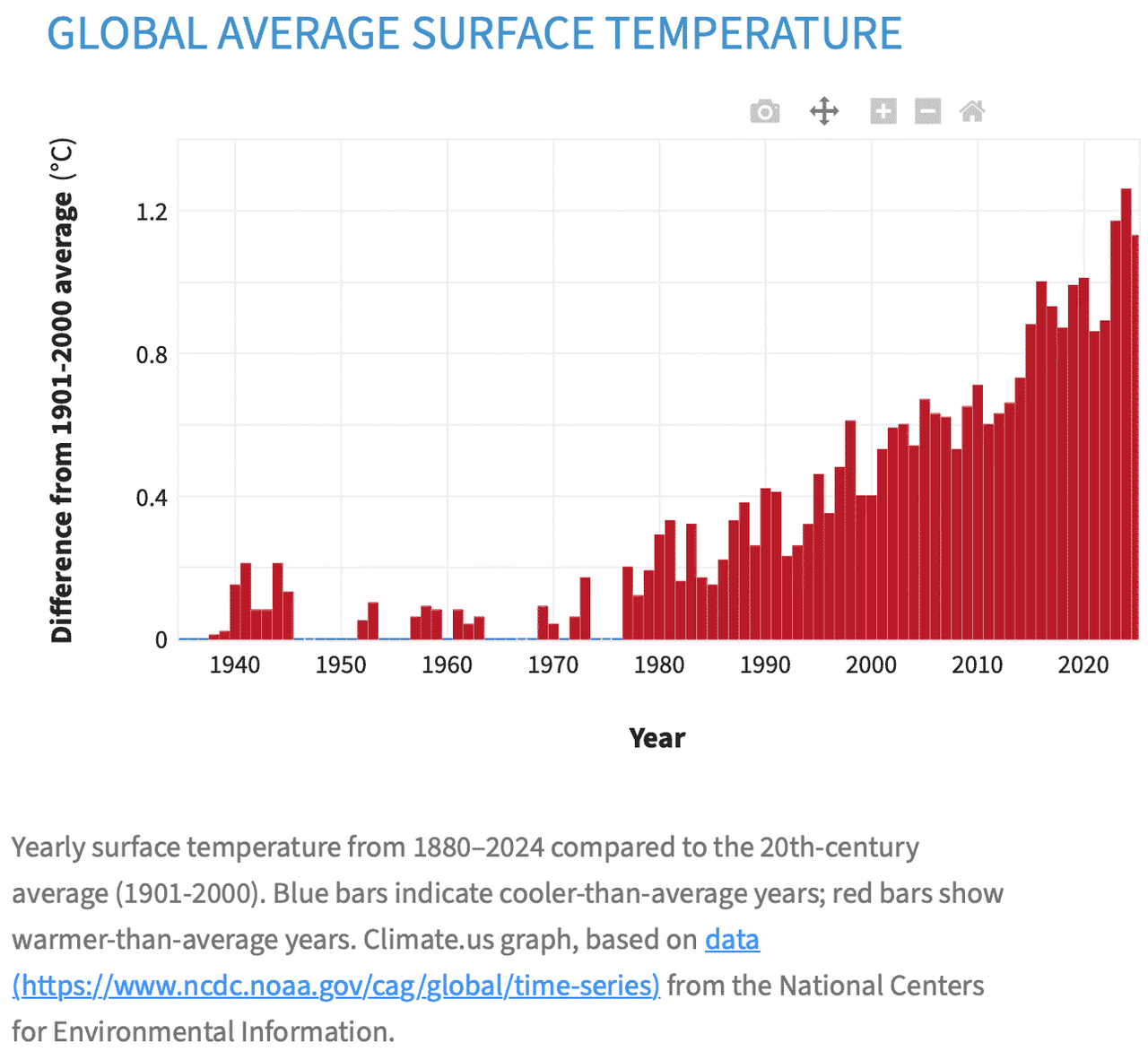
https://www.climate.us/news-features/understanding-climate/climate-change-global-temperature