Welcome to DU!
The truly grassroots left-of-center political community where regular people, not algorithms, drive the discussions and set the standards.
Join the community:
Create a free account
Support DU (and get rid of ads!):
Become a Star Member
Latest Breaking News
Editorials & Other Articles
General Discussion
The DU Lounge
All Forums
Issue Forums
Culture Forums
Alliance Forums
Region Forums
Support Forums
Help & Search
Environment & Energy
Related: About this forumWhy the Arctic's rivers are rusting - New study explains what's behind the toxic shift (impermafrost)
https://news.ucr.edu/articles/2026/06/01/why-arctics-rivers-are-rustingJules Bernstein
June 1, 2026
Scientists have identified the two biggest reasons that once-pristine rivers across the Arctic are growing cloudy with toxic orange iron particles that smother insects and suffocate fish.
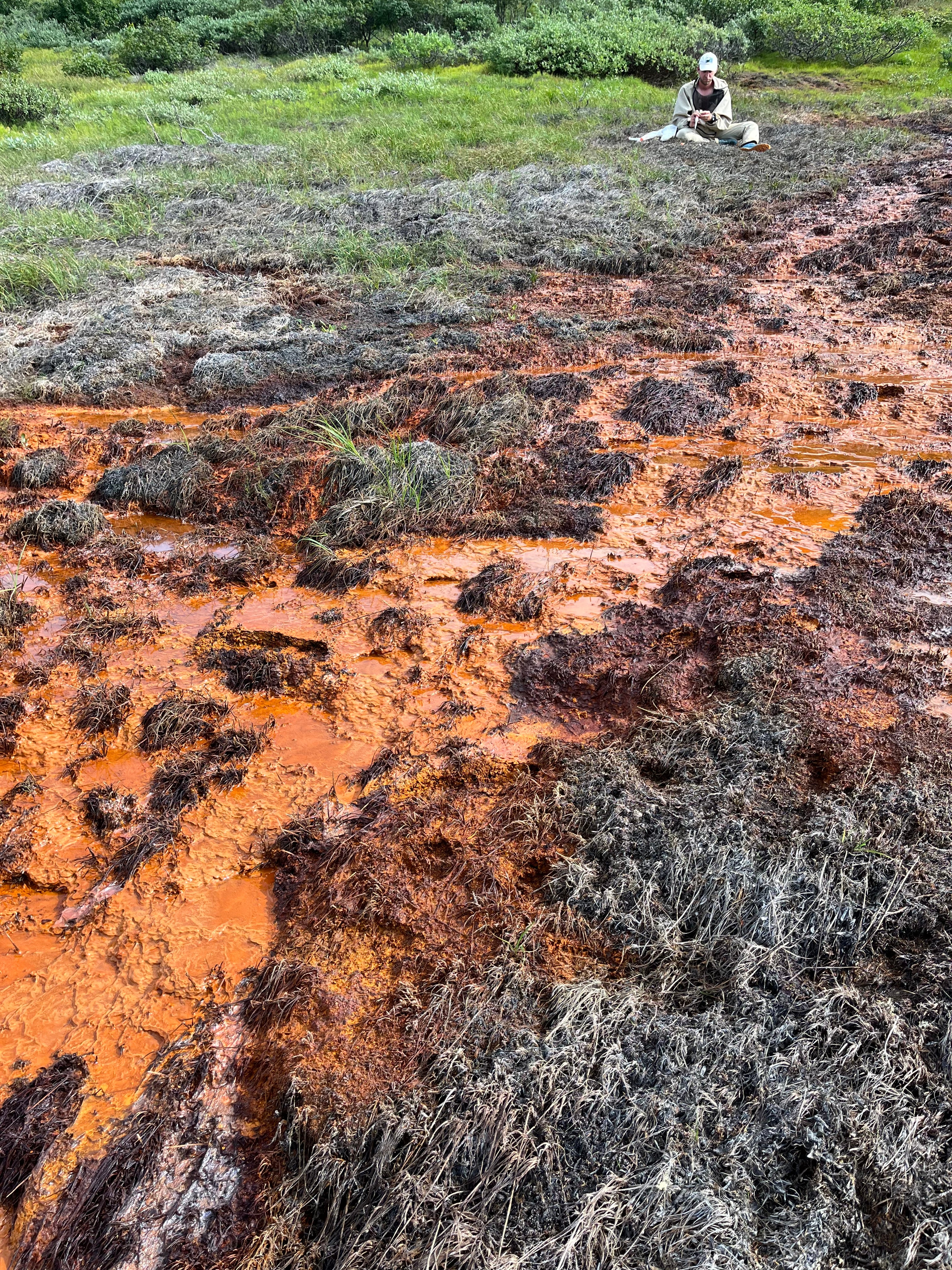
Unmistakable rusty hue in Alaskan waters. (Tim Lyons/UCR)
A new study published in Communications Earth & Environment builds on earlier research documenting widespread contamination in Alaska’s Brooks Range. As the climate warms, a layer of Arctic soil that had been frozen for millennia has begun to thaw. Previous studies suggested that thawing permafrost was the ultimate cause of the damage. This new study proves that beyond a shadow of a doubt.
The new study also reveals two distinct ways in which thawing soil is rusting rivers and helps scientists predict where the damage is likely to spread next.
To investigate the rusting, the research team studied a wide regional view of a vast mountain region, then zoomed in on a specific river system, followed by an even closer look at a single creek. This deep-dive allowed them to connect big patterns to specific, on-the-ground processes.
…
Dial, R.J., Hanna, C.T., Sullivan, P.F. et al. Permafrost thaw controls iron flux from wetlands and sulfide-bearing rocks to Arctic rivers and streams. Commun Earth Environ 7, 465 (2026). https://doi.org/10.1038/s43247-026-03450-xJune 1, 2026
Scientists have identified the two biggest reasons that once-pristine rivers across the Arctic are growing cloudy with toxic orange iron particles that smother insects and suffocate fish.
Unmistakable rusty hue in Alaskan waters. (Tim Lyons/UCR)
A new study published in Communications Earth & Environment builds on earlier research documenting widespread contamination in Alaska’s Brooks Range. As the climate warms, a layer of Arctic soil that had been frozen for millennia has begun to thaw. Previous studies suggested that thawing permafrost was the ultimate cause of the damage. This new study proves that beyond a shadow of a doubt.
The new study also reveals two distinct ways in which thawing soil is rusting rivers and helps scientists predict where the damage is likely to spread next.
To investigate the rusting, the research team studied a wide regional view of a vast mountain region, then zoomed in on a specific river system, followed by an even closer look at a single creek. This deep-dive allowed them to connect big patterns to specific, on-the-ground processes.
…
2 replies
 = new reply since forum marked as read
Highlight:
NoneDon't highlight anything
5 newestHighlight 5 most recent replies
= new reply since forum marked as read
Highlight:
NoneDon't highlight anything
5 newestHighlight 5 most recent replies
= new reply since forum marked as read
Highlight:
NoneDon't highlight anything
5 newestHighlight 5 most recent replies
Why the Arctic's rivers are rusting - New study explains what's behind the toxic shift (impermafrost) (Original Post)
OKIsItJustMe
15 hrs ago
OP
The findings also suggest the problem will expand globally. Similar conditions involving melting permafrost and metal-ri
riversedge
15 hrs ago
#1
Chirping canaries are good. It's when they stop chirping that there is a problem.
OKIsItJustMe
15 hrs ago
#2

riversedge
(81,768 posts)1. The findings also suggest the problem will expand globally. Similar conditions involving melting permafrost and metal-ri
..........In Alaska and neighboring Canada, the team suspects these changes are affecting salmon, which rely on clean gravel beds for spawning and on algae-based food webs during early life stages.
The findings also suggest the problem will expand globally. Similar conditions involving melting permafrost and metal-rich rocks exist in northern Canada, the Andes, and the Alps, for example.
“It’s already happening in Russia, and will keep happening anywhere you have the right geology and warming temperatures,” Lyons said. “It started as a canary in a coal mine in the Brooks Range, but now those canaries are chirping all over.”

OKIsItJustMe
(22,256 posts)2. Chirping canaries are good. It's when they stop chirping that there is a problem.
https://www.smithsonianmag.com/smart-news/what-happened-canary-coal-mine-story-how-real-life-animal-helper-became-just-metaphor-180961570/
What Happened to the Canary in the Coal Mine? The Story of How the Real-Life Animal Helper Became Just a Metaphor
The humble bird, which was employed until 1986, represents an important part of mining history
Kat Eschner; Updated by Sonja Anderson
Updated: March 7, 2024 | Originally Published: December 30, 2016
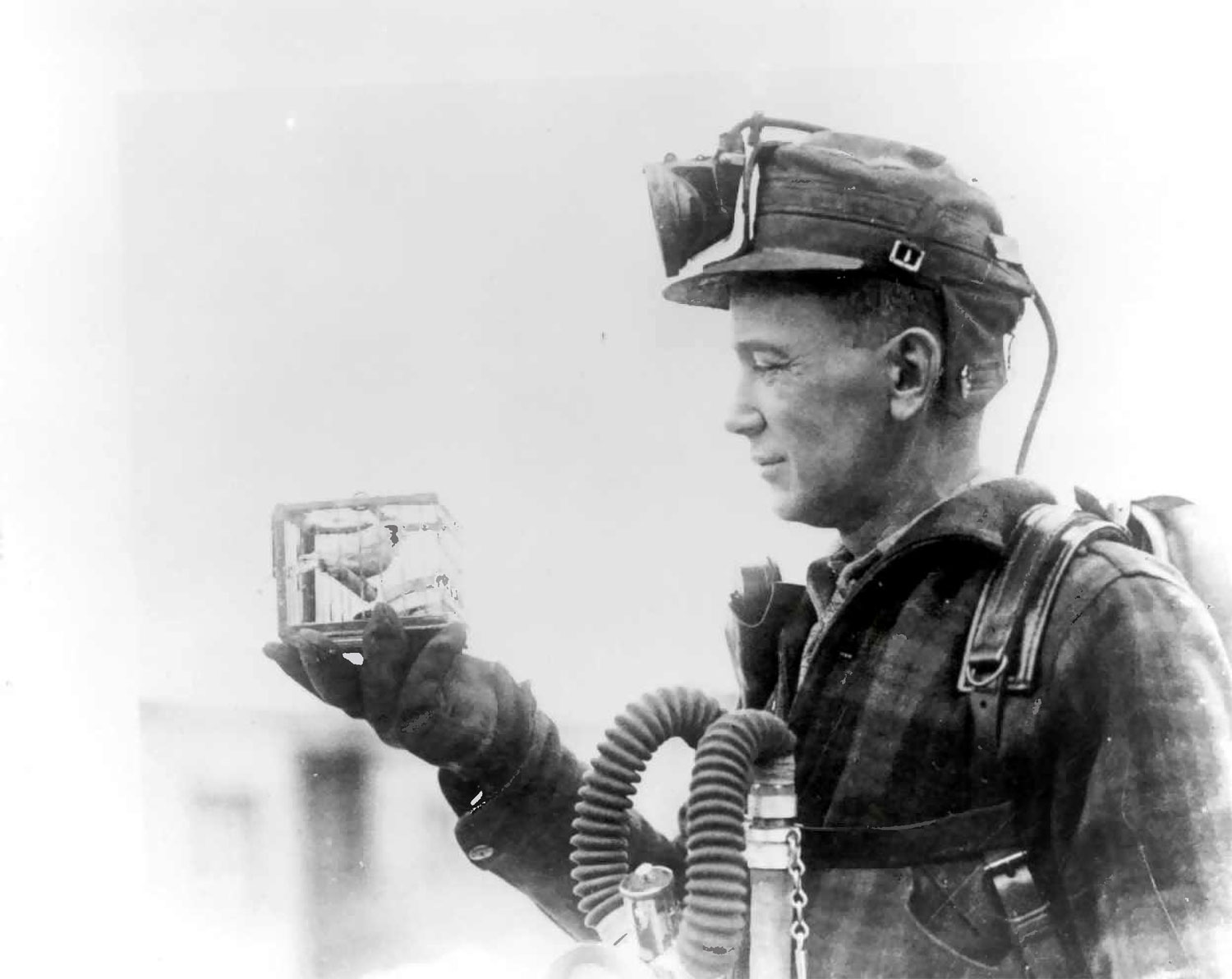
Mining foreman R. Thornburg shows a small cage with a canary used for testing carbon monoxide gas in 1928. George McCaa, U.S. Bureau of Mines
…
Throughout much of the 20th century, chirping canaries were staples of the coal mining industry. As coal miners descended into the earth—entering a harsh environment often home to poisonous gases like carbon monoxide—they would bring the yellow birds along as safety mechanisms. Because carbon monoxide is clear and odorless, miners needed a method for detecting a leak before it killed them. In the mine, a canary’s collapse let workers know there was poisonous gas in the air and gave them some warning time to evacuate.
But come 1981, the British government was planning the birds’ exodus, in favor of “electronic noses,” gas detectors with digital readings, as the BBC reported at the time. In December 1986, Britain officially outlawed the usage of canaries in the coal mines.
…
Though discontinuing canaries’ avian sacrifice was a step toward more humane treatment of animals, miners’ feelings were mixed. “They are so ingrained in the culture,” the BBC reported. “Miners report whistling to the birds and coaxing them as they worked, treating them as pets.”
The canary method was originally conceived by John Scott Haldane, “the father of oxygen therapy.” After an 1896 explosion at Tylorstown Colliery, Haldane was asked to help determine the cause of the blast. He concluded that carbon monoxide buildup was to blame, and he proposed using sentinel species in mines: animals more sensitive to poisonous gases than humans, which can be monitored to measure gas levels. His research on carbon monoxide led him to recommend using birds or mice.
…
The humble bird, which was employed until 1986, represents an important part of mining history
Kat Eschner; Updated by Sonja Anderson
Updated: March 7, 2024 | Originally Published: December 30, 2016
Mining foreman R. Thornburg shows a small cage with a canary used for testing carbon monoxide gas in 1928. George McCaa, U.S. Bureau of Mines
…
Throughout much of the 20th century, chirping canaries were staples of the coal mining industry. As coal miners descended into the earth—entering a harsh environment often home to poisonous gases like carbon monoxide—they would bring the yellow birds along as safety mechanisms. Because carbon monoxide is clear and odorless, miners needed a method for detecting a leak before it killed them. In the mine, a canary’s collapse let workers know there was poisonous gas in the air and gave them some warning time to evacuate.
But come 1981, the British government was planning the birds’ exodus, in favor of “electronic noses,” gas detectors with digital readings, as the BBC reported at the time. In December 1986, Britain officially outlawed the usage of canaries in the coal mines.
…
Though discontinuing canaries’ avian sacrifice was a step toward more humane treatment of animals, miners’ feelings were mixed. “They are so ingrained in the culture,” the BBC reported. “Miners report whistling to the birds and coaxing them as they worked, treating them as pets.”
The canary method was originally conceived by John Scott Haldane, “the father of oxygen therapy.” After an 1896 explosion at Tylorstown Colliery, Haldane was asked to help determine the cause of the blast. He concluded that carbon monoxide buildup was to blame, and he proposed using sentinel species in mines: animals more sensitive to poisonous gases than humans, which can be monitored to measure gas levels. His research on carbon monoxide led him to recommend using birds or mice.
…