Welcome to DU!
The truly grassroots left-of-center political community where regular people, not algorithms, drive the discussions and set the standards.
Join the community:
Create a free account
Support DU (and get rid of ads!):
Become a Star Member
Latest Breaking News
Editorials & Other Articles
General Discussion
The DU Lounge
All Forums
Issue Forums
Culture Forums
Alliance Forums
Region Forums
Support Forums
Help & Search
Environment & Energy
Related: About this forumNew method turns ocean water into drinking water, without waste
https://www.rochester.edu/newscenter/what-is-desalination-definition-ocean-water-704732/Luke Auburn | Director of Communications, Hajim School of Engineering & Applied Sciences
May 27, 2026
The energy-efficient desalination system produces fresh water without chemical additives and transforms leftover salts into useful materials.
Big takeaways
The United Nations estimates that 2.2 billion people lack safely managed drinking water, and communities from California to the Middle East rely on desalination plants to convert ocean water to fresh water. Common desalination techniques, such as reverse osmosis and thermal distillation, are energy-intensive, require pre- and post-water treatment, and leave behind a concentrated saltwater byproduct called brine. The brine byproduct wreaks havoc on sea life when it’s deposited back into the ocean by raising the salt level and lowering oxygen in the water.
But a novel approach developed at the University of Rochester offers a way to overcome these drawbacks. Researchers at URochester’s Institute of Optics developed a new solar-thermal desalination process to produce fresh water in an energy-efficient way that does not leave behind brine and requires no chemical additives to pre-treat the water. A team led by Chunlei Guo, a professor of optics and of physics and a senior scientist at URochester’s Laboratory for Laser Energetics, describes their method in a paper published in Light: Science & Applications.
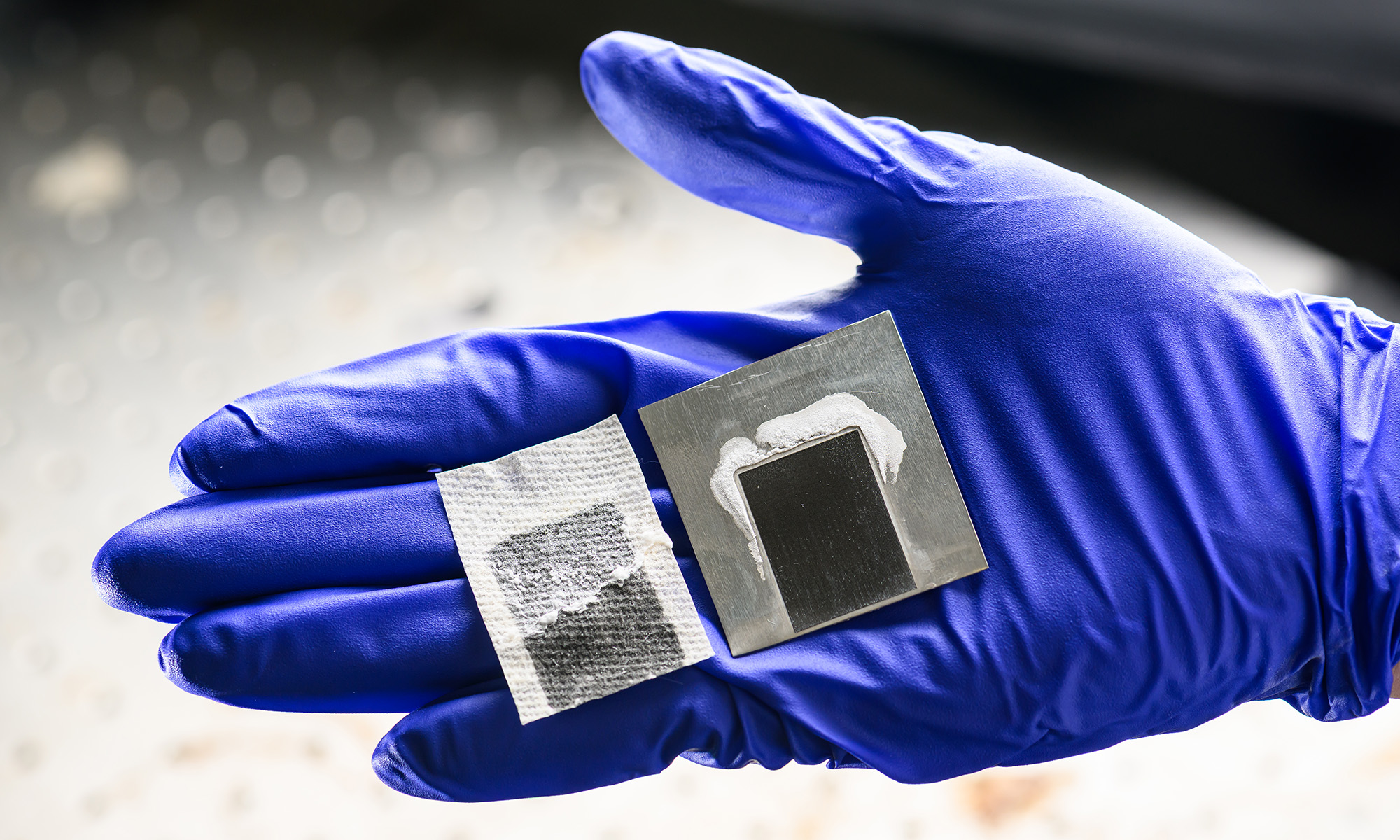
SUN-POWERED SOLUTION: Researchers developed a solar-powered desalination device featuring laser-etched superwicking black metal (right). Unlike existing solar desalination systems (left), Professor Chunlei Guo’s design prevents salt and mineral buildup from clogging the surface. (University of Rochester photo / J. Adam Fenster)
The technology uses solar panels made of black metal etched with femtosecond lasers to make the surface super light-absorbing and superwicking—or extremely attractive to water. The panels have a laser-treated active region that pulls a thin layer of water across the surface, absorbs nearly all solar radiation, distills the water, and deposits the leftover salts and minerals into the panel’s untreated sides or “passive” region so that the salt does not clog the active region and disrupt continuous desalination.
…
Tang, L., Singh, S.C., Wei, R. et al. Additive-free and brine-discharge-free solar-thermal desalination with simultaneous complete mineral mining from ocean water. Light Sci Appl 15, 246 (2026). https://doi.org/10.1038/s41377-026-02315-4May 27, 2026
The energy-efficient desalination system produces fresh water without chemical additives and transforms leftover salts into useful materials.
Big takeaways
- A new desalination method produces drinking water from seawater without chemical additives.
- The solar-powered system uses specially engineered black metal to absorb sunlight.
- Its self-cleaning surface separates and collects salts, instead of dumping them as harmful brine waste.
- From the salts, the system can extract lithium, a key material for rechargeable batteries.
- The approach could help address global water shortages and growing mineral demand.
The United Nations estimates that 2.2 billion people lack safely managed drinking water, and communities from California to the Middle East rely on desalination plants to convert ocean water to fresh water. Common desalination techniques, such as reverse osmosis and thermal distillation, are energy-intensive, require pre- and post-water treatment, and leave behind a concentrated saltwater byproduct called brine. The brine byproduct wreaks havoc on sea life when it’s deposited back into the ocean by raising the salt level and lowering oxygen in the water.
But a novel approach developed at the University of Rochester offers a way to overcome these drawbacks. Researchers at URochester’s Institute of Optics developed a new solar-thermal desalination process to produce fresh water in an energy-efficient way that does not leave behind brine and requires no chemical additives to pre-treat the water. A team led by Chunlei Guo, a professor of optics and of physics and a senior scientist at URochester’s Laboratory for Laser Energetics, describes their method in a paper published in Light: Science & Applications.
SUN-POWERED SOLUTION: Researchers developed a solar-powered desalination device featuring laser-etched superwicking black metal (right). Unlike existing solar desalination systems (left), Professor Chunlei Guo’s design prevents salt and mineral buildup from clogging the surface. (University of Rochester photo / J. Adam Fenster)
The technology uses solar panels made of black metal etched with femtosecond lasers to make the surface super light-absorbing and superwicking—or extremely attractive to water. The panels have a laser-treated active region that pulls a thin layer of water across the surface, absorbs nearly all solar radiation, distills the water, and deposits the leftover salts and minerals into the panel’s untreated sides or “passive” region so that the salt does not clog the active region and disrupt continuous desalination.
…
9 replies
 = new reply since forum marked as read
Highlight:
NoneDon't highlight anything
5 newestHighlight 5 most recent replies
= new reply since forum marked as read
Highlight:
NoneDon't highlight anything
5 newestHighlight 5 most recent replies
= new reply since forum marked as read
Highlight:
NoneDon't highlight anything
5 newestHighlight 5 most recent replies
New method turns ocean water into drinking water, without waste (Original Post)
OKIsItJustMe
8 hrs ago
OP
Most cars would not get enough energy from a solar panel on their roofs however...
OKIsItJustMe
5 hrs ago
#4
Another e.g. of why US universities have led the world in basic research, & DARPA's led in turning that into technology.
ancianita
5 hrs ago
#7
My geekish niece and her geekish husband and child live just outside of Rochester proper
OKIsItJustMe
1 hr ago
#9

Teacher of the Year
(240 posts)1. Happy to be the first to comment!! YAY
This is a major breakthrough, it sounds like.
This is silly but I dreamed of something like this. In the dream every car's roof was a solar panel-no more gas, pipes pulled water up from the ocean, took out the salt as it travelled up to Lake Mead and the head of the Colorado river, to be released.
Crazy dream, but I'm ready for all of that!

OKIsItJustMe
(22,237 posts)4. Most cars would not get enough energy from a solar panel on their roofs however...

Wild blueberry
(8,385 posts)2. WOW
Hurray for science!
Thank you.
OKIsItJustMe
(22,237 posts)5. You're welcome!
Hopefully, it will scale well.

FakeNoose
(42,608 posts)3. Amazing and wonderful to hear.... this is a game-changer!
Thank you to the brilliant scientists and the University of Rochester (New York)!


chowder66
(12,565 posts)6. Keep the top 10% away from this.

ancianita
(43,399 posts)7. Another e.g. of why US universities have led the world in basic research, & DARPA's led in turning that into technology.

SergeStorms
(20,897 posts)8. My hometown comes through again.
Rochester has always been a hub of innovation and research. Some good, some not so good, but we're always thinking around here! 🤔
OKIsItJustMe
(22,237 posts)9. My geekish niece and her geekish husband and child live just outside of Rochester proper
They’re all great, original thinkers.