Welcome to DU!
The truly grassroots left-of-center political community where regular people, not algorithms, drive the discussions and set the standards.
Join the community:
Create a free account
Support DU (and get rid of ads!):
Become a Star Member
Latest Breaking News
Editorials & Other Articles
General Discussion
The DU Lounge
All Forums
Issue Forums
Culture Forums
Alliance Forums
Region Forums
Support Forums
Help & Search
Environment & Energy
Related: About this forum
Heatwaves in high 40 degrees Celsius are 'new normal' for India and Pakistan, scientists warn
A quick review:40°C = 104°F
45°C = 113°F
50°C = 122°F
I’m curious to know what the WBGT readings were.
https://www.independent.co.uk/climate-change/news/india-pakistan-heatwave-deaths-b2977059.html
Climate crisis has tripled the likelihood of extreme heat occurring, study finds
Stuti Mishra
Friday 15 May 2026 06:54 BST
Temperatures reaching the high 40 degrees Celsius across India and Pakistan are no longer extreme weather events but a regular feature of the pre-monsoon season, scientists have warned.
The finding comes from a rapid attribution study by World Weather Attribution, an international scientific collaboration that analyses the role of the human-caused climate crisis in extreme weather events.
The study, published on Thursday, examined a prolonged period of extreme heat that struck India and Pakistan between mid-April and early May, when daily maximum temperatures exceeded 46C in several cities, causing at least 37 heat-related deaths in India and 10 in Karachi, Pakistan.
The study found climate crisis has tripled the likelihood of such heat occurring and the window of dangerous temperatures growing longer every year.
…
Stuti Mishra
Friday 15 May 2026 06:54 BST
Temperatures reaching the high 40 degrees Celsius across India and Pakistan are no longer extreme weather events but a regular feature of the pre-monsoon season, scientists have warned.
The finding comes from a rapid attribution study by World Weather Attribution, an international scientific collaboration that analyses the role of the human-caused climate crisis in extreme weather events.
The study, published on Thursday, examined a prolonged period of extreme heat that struck India and Pakistan between mid-April and early May, when daily maximum temperatures exceeded 46C in several cities, causing at least 37 heat-related deaths in India and 10 in Karachi, Pakistan.
The study found climate crisis has tripled the likelihood of such heat occurring and the window of dangerous temperatures growing longer every year.
…
https://www.worldweatherattribution.org/climate-change-exposes-hundreds-of-millions-to-longer-and-deadlier-pre-monsoon-heat-in-south-asia/
Climate change exposes hundreds of millions to longer and deadlier pre-monsoon heat in South Asia
14 May, 2026
Heatwave
From mid April and advancing into May, India and Pakistan experienced extremely high temperatures, including daily maximum temperatures above 46°C in many cities in India (Times of India, 2026).
This ongoing period of extreme heat brought severe human and economic impacts across India and Pakistan (Al Jazeera, 2026), two of the most densely populated regions in the world, exposing hundreds of millions of people to dangerous conditions. At least 37 heat-related deaths were reported in India (The Wire, 2026), while ten deaths were recorded in Karachi, Pakistan (Tribune, 2026). The event also drove record-high electricity demand across India as cooling needs surged (The Wire, 2026), while agricultural drought conditions affected over 1mio km² (GDACS, 2026), compounding risks to food production and livelihoods. Beyond these direct impacts, the heat coincided with major election periods in the region, raising concerns about voter safety, campaign disruptions, and broader pressures on public infrastructure and health systems (The Times of India, 2026) while potentially taking attention away from the acute dangers of heat.
According to the IPCC AR6, based on many studies, there is a well-established and robust link between anthropogenic climate change and the increasing frequency, intensity, and duration of extreme heat events in South Asia, making such episodes significantly more likely in today’s warmer climate (Seneviratne et al., 2021). With World Weather Attribution, we have also undertaken several attribution studies on extreme heat events in India and South Asia, including May 2024, April 2023, March to May 2022 and May 2016 when temperatures of over 50°C were reached in Phalodi, Rajasthan. While the more recent studies have shown a strong increase in likelihood and intensity of extreme dry and humid heat in the region, the 2016 study did show smaller increases. The study, published in a peer-reviewed journal (van Oldenborgh et al., 2018) concluded that “for the next decades we expect the trend due to global warming to continue but the surface cooling effect of aerosols to diminish as air quality controls are implemented”. A decade on, we perform a super-rapid attribution study that updates the 2022 attribution analysis, as this year’s heatwave affected broadly similar regions and reached a comparable spatial extent. We also examine how the likelihood and intensity of an event such as this one have changed in today’s climate as compared with the 2016 climate conditions, when a similarly severe heat event occurred in the region, against a backdrop of ENSO and widespread drought.
14 May, 2026
Heatwave
From mid April and advancing into May, India and Pakistan experienced extremely high temperatures, including daily maximum temperatures above 46°C in many cities in India (Times of India, 2026).
This ongoing period of extreme heat brought severe human and economic impacts across India and Pakistan (Al Jazeera, 2026), two of the most densely populated regions in the world, exposing hundreds of millions of people to dangerous conditions. At least 37 heat-related deaths were reported in India (The Wire, 2026), while ten deaths were recorded in Karachi, Pakistan (Tribune, 2026). The event also drove record-high electricity demand across India as cooling needs surged (The Wire, 2026), while agricultural drought conditions affected over 1mio km² (GDACS, 2026), compounding risks to food production and livelihoods. Beyond these direct impacts, the heat coincided with major election periods in the region, raising concerns about voter safety, campaign disruptions, and broader pressures on public infrastructure and health systems (The Times of India, 2026) while potentially taking attention away from the acute dangers of heat.
According to the IPCC AR6, based on many studies, there is a well-established and robust link between anthropogenic climate change and the increasing frequency, intensity, and duration of extreme heat events in South Asia, making such episodes significantly more likely in today’s warmer climate (Seneviratne et al., 2021). With World Weather Attribution, we have also undertaken several attribution studies on extreme heat events in India and South Asia, including May 2024, April 2023, March to May 2022 and May 2016 when temperatures of over 50°C were reached in Phalodi, Rajasthan. While the more recent studies have shown a strong increase in likelihood and intensity of extreme dry and humid heat in the region, the 2016 study did show smaller increases. The study, published in a peer-reviewed journal (van Oldenborgh et al., 2018) concluded that “for the next decades we expect the trend due to global warming to continue but the surface cooling effect of aerosols to diminish as air quality controls are implemented”. A decade on, we perform a super-rapid attribution study that updates the 2022 attribution analysis, as this year’s heatwave affected broadly similar regions and reached a comparable spatial extent. We also examine how the likelihood and intensity of an event such as this one have changed in today’s climate as compared with the 2016 climate conditions, when a similarly severe heat event occurred in the region, against a backdrop of ENSO and widespread drought.
…
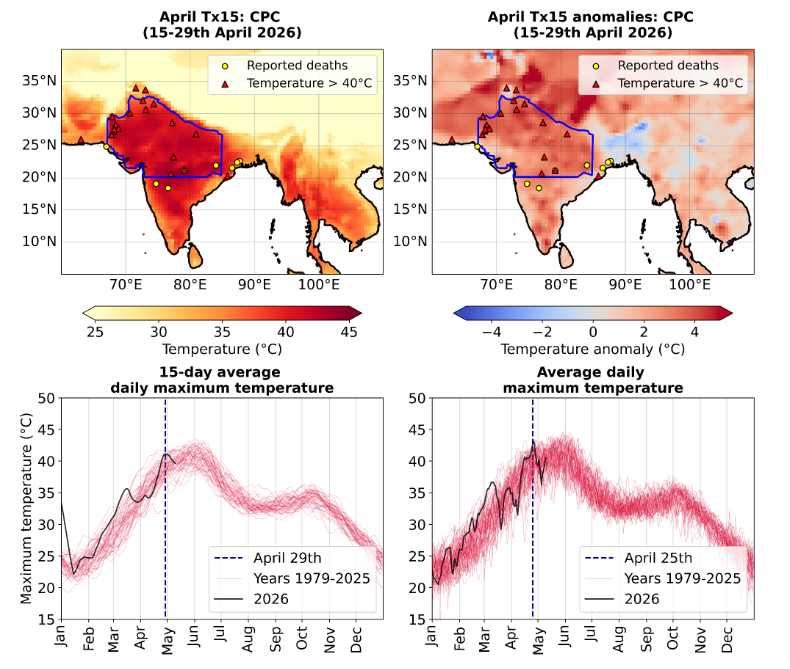
Figure 1: Top left: 15-day mean of daily maximum temperature (Tmax) for 15-29 April, 2026. The study region is outlined in blue, with locations with reported deaths highlighted with yellow circles and locations exceeding 40℃ shown as red triangles. Top right: Temperature anomaly associated with the same event, relative to a climatological mean derived from 15-day mean of Tmax averaged over all days of April during 1991-2020 period. Bottom left: Evolution of 15-day running mean of Tmax, area-averaged over the study region. The red lines show the interannual variability for the duration over which CPC records are available i.e. 1979-2026. The black line highlights the 2026 trajectory. The 15-day event ending on 29 April 2026 (shown by dotted black line) is the highest since the beginning of the year. Bottom right: same as (bottom left), but for daily TMax area-averaged over the study region. The black dashed line highlights the hottest peak, which occurred on 25 April 2026.