The DU Lounge
Related: Culture Forums, Support Forums5 Reasons Why Shakespeare Should Not Be Required in Schools
5. The language is archaic and many meanings have changed in the 403 years since it was published. Like the French spoken in Quebec, the version of English used in Shakespeare is not modern. The Quebecois were isolated from the evolution of the French language for centuries and this produced not benefits for them. Forcing students to slog through an archaic version of English is appropriate for language and English majors but not for general education.
4. The subject matter is elitist and no longer relevant. "My kingdom for a horse" is not the kind of problem most students are facing today. Nor is having your mother marry your uncle after your uncle kills your father. Monarchy, royal successions, "gunpowder" plots have as much relevance today as alchemy and humorism. Shakespeare's audience and patron was Queen Elizabeth. Her priorities are quite different than anyone's today.
Worse, the nobles speak in iambic pentameter while the middle and lower class don't. The lower classes are made fun of and given derogatory names such as "Pompey Bum" and "Mistress Overdone".
3. It is terrible as drama. One actor shouts a long monologue while the rest hold a frozen expression of reaction. Completely unnatural. A stylized version of stage acting that is closer to a poetry reading than interactive drama. The length of many works suggests that the form we have was intended for reading. 'Hamlet' with over 30,000 words would be over 5 hours long if performed in its entirety. Today most of the plays are performed in heavily edited versions.
2. The music is long gone. Imagine trying to watch 'The Lion King' or 'Oklahoma' or 'Chicago' without the music! Yet we are supposed to pretend that people speaking lyrics with no musical backing is perfectly acceptable and normal.
1. There is plenty of far better material available now. Relevant. Thought-provoking. "12 Angry Men" "To Kill a Mockingbird" "A Raisin in the Sun" "Our Town" "Death of a Salesman" "The Glass Menagerie" "The Crucible" "Streetcar Named Desire" "Doubt"
 = new reply since forum marked as read
Highlight:
NoneDon't highlight anything
5 newestHighlight 5 most recent replies
= new reply since forum marked as read
Highlight:
NoneDon't highlight anything
5 newestHighlight 5 most recent replies

hlthe2b
(114,004 posts)I'm reminded of those master's degree candidates I TRIED to mentor whose grasp of the English language, spelling, grammar, and inability to express a complex thought were met with such disdain and arrogance toward going back and remedying those deficits. I am thrilled when I occasionally meet the "exception to that rule."

GreatGazoo
(4,634 posts)It is monarchist propaganda and suicidal ideation. Plenty of great lines and great ideas but should not be anyone's intro to dialectic.
Turns students off to how good theater CAN be.
hlthe2b
(114,004 posts)We get it. You are anti-Royalist and all things UK. Good for you, I guess. The rest of us are a bit more discerning to facts and evidence (and motivations for certain posts).
GreatGazoo
(4,634 posts)The rest is nothing that Brits haven't pointed out. I like the UK and Brits admit it is quirky. I'm calling balls and strikes. Shakespeare is good and challenging stuff but it isn't something that should be forced on students. I have yet to read you argue why it should be.
It is true that the UK has more horses than tanks. Note the source:
BBC: Why does the British Army have more horses than tanks?
https://www.bbc.com/news/uk-scotland-highlands-islands-22951548
You haven't refuted anything I wrote. Just called me names and made sweeping assumptions.
hlthe2b
(114,004 posts)I did not call you names. I called you on your apparent disdain for all things UK. I am equivocal about much, but I certainly don't have that seeming antipathy--particularly given their rich history, from which we can learn a great deal.
Ironically, you have just proven how much reading some Shakespeare would benefit you. I suspect history isn't your thing either, but I hope that is not the case.
"You are anti-Royalist and all things UK" etc. Post #7 here. Water off a duck but you still have not refuted anything just ad hom and now gas lighting, ("I did not call you names" .
.
Turns out the UK does have more horses than tanks just I asserted. Strange but true. If the UK wants to have more horses than tanks that is their choice. You were wrong and very confident about it ("BS" . Apology accepted in advance.
I know English history well and have toured the country several times. Have been to the fake Globe theater and have seen excellent theater productions in the West End. England has a strong theatrical tradition and great support for the arts. A key distinction between the US and UK came with the birth of broadcast radio around 1922. The USA used interruption advertising while the UK created the BBC with the idea that media should educate and elevate in ways that made commercial sponsorships incompatible.
I like parts of Shakespeare but in my own experience growing up in a theatrical family, sitting through live Shakespeare as a child was a real turn off, not just to Shakespeare but to live theater in general. The first live theater I liked was "Stop the World I Want to Get Off" with Anthony Newly and then an excellent amateur production of 'Guys and Dolls'. Forcing anyone to sit through 3 hours of shouted iambic pentameter (Shakespeare) that they barely, or do not at all, understand is a disservice to them and to theater.
hlthe2b
(114,004 posts)And yes, discussed the horse vs. tank issue accurately-had you actually read my posts to you.
I hope you actually DO spend time learning and enjoying history, but the themes from Shakespeare's plays are absolutely those of history AND (in the words of Santayana) provide those lessons man continues to fail to learn from and thus to repeat. I'll leave it there.

wnylib
(26,048 posts)1. His plays show how people lived in his time, so they have historical as well as literary value.
2. The plays are available with margin and foot notes to explain archaic words or objects.
3. Students can expand their minds and thinking processes by making a little extra effort to understand passages and plots.
4. They show that, although language and technology change, some basic things about human nature remain the same throughout centuries.
5. Numerous everyday expressions come from Shakespeare's plays, so they are still relevant.
6. Shakespeare's eloquence is unmatched by any other writer that I know of. Students deserve to be exposed to it.
Regarding other good literary works that you mentioned, there is no reason why they can't be covered, too, over 4 years of high school. It does not need to be either/or.
GreatGazoo
(4,634 posts)Agree with all except 1 and 6
1. The history plays are Tudor propaganda. Unbalanced and inaccurate by design.
Many other plays are reworks of earlier publications of Italian (All’s Well That Ends Well, Cymbeline and The Two Gentlemen of Verona, heavy influence of Boccaccio) , French (Love’s Labour’s Lost) and Danish (Hamlet is based on 'Amleth' by Saxo Grammaticus, ~1200CE) stories. Shakespeare adapts 'Hamlet' from the French translation from Danish done by Belleforest. We know this because Shakespeare makes more than fifty allusions to characters, events or words and phrases in Belleforest’s Les Histoires Tragiques.
Locations and cultures are transposed. Interesting. Entertaining but not accurate history. Until very recently history was strictly a branch of literature, eg of fiction. The kind of history that says Rome is started by Romulus and Remus who were nursed by a wolf. History is more forensic and fact based now. Thomas Jefferson's miracle-free Bible was emblematic of the turning point from fictional history to fact-seeking.
6. Marlowe and Jonson were easily as good as the best Shakespeare stuff. There is a lot of grammatical error in Shakespeare that remains uncorrected. I looked into the original wording and punctuation of "We are such stuff as dreams are made on, (sic) and our little life (sic) is rounded with a sleep." It was worse in the 1623 portfolio but even now there are two obvious grammar errors (or typos). That IMHO is the problem with using only superlatives and pretending it is all perfect.
To be more clear, I love that line but I think the lack of correction shows the confusion this stuff can bring to less confident readers and, to my original point, students. I also think convolutions are part of the appeal. It's like Yoda. It sounds smarter because it is convoluted or errant yet enshrined like gospel.
wnylib
(26,048 posts)Last edited Wed Apr 1, 2026, 10:33 PM - Edit history (1)
historically accurate. Was not even referring to the history plays. I was referring to things like the language used and the customs portrayed, e. g. how personal feuds and grievances were avenged, belief in witchcraft (Macbeth) and ghosts (Hamlet).
Yes, I know that Shakespeare's plots were borrowed and rewritten from different times and places. I know that the historical plays had to conform to the Crown's views because Ellizabeth was a patron. But his ability to evoke emotion and to tell a story is good.
On grammar, Shakespeare was quite..um..."innovative" in his use of words, expressions, grammar, and in making up words. Consequently, his plays introduced meanings and expressions that have become commonplace and frequently quoted. His influence on the English language is tremendous.
I agree that Marlowe and Johnson were good, but believe that Shakespeare was better at portraying human nature and appealing across classes. But, I have to admit that I am more familiar with Shakespeare than with the other two.
I also love Shakespeare's sonnets. My favorite is "My mistress's eyes..." I don't remember the number of that sonnet. I love it for its humorous jabs at hyperbolic poets while conveying that sincerity of feeling is better than flowery fantasies.
GreatGazoo
(4,634 posts)So much was happening at once and so much of it set in motion the world we live in now.
I have researched Henry Hudson (1565 - c1611) off and on for about 7 years now. London is a fairly small community at that time. Smaller still when you get down to only those who can write and who have access to patrons. Walter Raleigh, John Dee, Haklyut, Hudson, etc. London was the last place in Europe to get printing presses and there were only 25 master printers. England goes from forgotten Roman backwater to globe-spanning empire in one sustained push.
I assume the sonnets were never intended for publication. They are cryptic unless we know who is writing to whom.
This is some of Shakespeare's best:
Creeps in this petty pace from day to day,
To the last syllable of recorded time;
And all our yesterdays have lighted fools
The way to dusty death. Out, out, brief candle!
Life's but a walking shadow, a poor player,
That struts and frets his hour upon the stage,
And then is heard no more. It is a tale
Told by an idiot, full of sound and fury,
Signifying nothing.
But is it any better than this:
Perhaps to be too practical is madness.
To surrender dreams — this may be madness.
Too much sanity may be madness — and
maddest of all: to see life as it is, and not as it should be!”
- Cervantes
wnylib
(26,048 posts)I use it to illustrate why Shakespeare was such a great writer even though his plots were not original and his history not accurate. You could sum up that quote in modern English and it would pale against how Shakespeare said it. Not quite as eloquent if you just say, "Don't take yourself and life too seriously. What's your importance? You're just one person among many before and after you."
Cervantes -- Spanish was my major. We read Don Quixote in the original Spanish.
GreatGazoo
(4,634 posts)and while I was waiting for the tow I saw something written in pencil on the back of road sign. I looked closer: "Tomorrow and tomorrow..." the whole bit.
Years later 8AM I was getting off the subway, 50th and Broadway. High schoolers get off that stop with the rest of us. Two of them right in front of me:
A: Did you learn that shit?
B: Of course
A: You did not.
B: I did
A: Prove it
B: Tomorrow and tomorrow and tomorrow... (etc.)
wnylib
(26,048 posts)Speaking of students quoting Shakespeare, when I was in high school, we had students monitors in the halls and cafeteria. They could give out detention slips to students who broke rules after getting a warning, and stop them to check for a hall pass if they were in the halls during class time.
After reading Hamlet, they quoted it when stopping someone. "Stand and unfold yourself!"
In chemistry class, someone would pop up with, "Fire burn and cauldron bubble." (Macbeth)
Response to wnylib (Reply #18)
NNadir This message was self-deleted by its author.

Jilly_in_VA
(14,394 posts)and worthy of the name you give yourself. I say that in all sincerity.

A-Schwarzenegger
(15,818 posts)who convince themselves
they are not trolls. 

Mme. Defarge
(9,024 posts)Describing the character of Malvolio in Shakespeare’s Twelfth Night,
“so crammed, as he thinks, with excellencies that it is his grounds of faith that all that look on him love him.”

MyOwnPeace
(17,568 posts)Is your knitting finished? 
Mme. Defarge
(9,024 posts)so little time.
MyOwnPeace
(17,568 posts)who actually read it in my English class. It was a 'guaranteed 'A' to be doing that, but it was the 2 of us that kept the discussion going for the entire 45 minutes - while the rest of the class stared at their shoes!

cachukis
(3,953 posts)high brow.
Learning Emily Post is passe, but lacking manners is not.

perfessor
(379 posts)Shakespeare wasn’t that great. All he did was string together a bunch of well-known sayings.
And with that I will exit stage left.
GreatGazoo
(4,634 posts)"School was easier in Shakespeare's day because they didn't have to study Shakespeare."
Wonder Why
(7,043 posts)hlthe2b
(114,004 posts)So, I guess I should not be surprised at this particular meme either. Whether they have 334 tanks or 30, this just seems like a concerted hit piece on the UK. We get it. You don't like the UK, Shakespeare, the monarchy or all things British. Gotcha. (and as to the tank deficit, G. Britain is working to reverse that trend, especially now that your MAGA President is making grunts about leaving NATO)... 
https://www.democraticunderground.com/?com=view_post&forum=1002&pid=21136488

eppur_se_muova
(41,967 posts)I haven't seen "The Glass Menagerie", but if it's like Tennessee Williams' other plays, it involves deeply damaged characters treating each other sadistically just for the Hell of it. Rather like watching someone tear the wings off of flies just to be entertained by their suffering.
Williams grew up in a dysfunctional family with an alcoholic father and later became an alcoholic himself. He wrote about dysfunctional relationships because that's what he knew. That doesn't make it worthy of the name of "art".
Williams wrote more than 70 plays (including collaborations). Most are forgotten. More should be.
PS: Yes I know it's April Fools' Day. But some of the recommended plays are far less appropriate for a high school class than anything Shakespeare ever wrote. (BTW, we read "Our Town" in high school. BOOOOOOring. And the idea of performing without a real set is just too pretentious for words.) You won't be surprised that I'm not a fan of theater, and wouldn't likely attend a live play even with free tickets.
GreatGazoo
(4,634 posts)surprisingly good. Didn't think I would like it.
Students may like or dislike Streetcar but at least they will understand it. Unlike:
If you dare venture in your own behalf,
A mistress's command. Wear this; spare speech;
Decline your head: this kiss, if it durst speak,
Would stretch thy spirits up into the air.

CTyankee
(68,217 posts)Blanche Dubois said: "Deliberate cruelty cannot be forgiven." His voice, through her character, was so tragic.
appmanga
(1,495 posts)...and I don't get why we should go down a path where education is somehow supposed to be bereft of challenge, and people should only take in what they would natively understand. That's the concept that gives us flat-Earthers and fundamentalists. The idea of education is to go beyond what we don't immediately understand, that we can get beyond the denseness of a style of writing in order not just to understand what the writer is saying, but that there may be better ways of saying it, or maybe not. And that's just one way to approach that stanza.
Jilly_in_VA
(14,394 posts)Along with "Glass Menagerie" and "Come Back, Little Sheba" and the rest of Tennessee Williams.

MorbidButterflyTat
(4,527 posts)Tennessee Williams plays are horrible.
Along with others listed, "Baby Doll." Sick characters doing sick things to each other. 
And "Suddenly, Last Summer." Have bad memories? Get a lobotomy! 
eppur_se_muova
(41,967 posts)Has the same thrill as tossing two beetles in a jar and watching them fight to the death.
The climactic scene of Streetcar is a forcible rape, fergodsake.

Walleye
(44,862 posts)Especially the ones where the girls outsmarted the boys
GreatGazoo
(4,634 posts)performed live or video?
I agree that much of it reads well but it is terrible when staged.
wnylib
(26,048 posts)by junior college students put on for the general community. The characters came alive and drew the audience into their schemes and interactions. I saw it during the Reagan/Bush era and could well relate to a line in the play about the suffering of a nation when the rulers are corrupt.

ProfessorGAC
(76,742 posts)And, I mostly concur.
But, it won't be dropped from any curricula.
questionseverything
(11,846 posts)Back when I was in school, aren’t they still studied?
Wonder Why
(7,043 posts)

Rizen
(1,086 posts)of Shakespeare. This isn't a matter of what plays you think are relevant to modern culture, it's about teaching works with significant historical impact. Most of your complaints about Shakespeare could really transition to any historical piece. Should we not teach the Odyssey or the Iliad because they don't apply to modern life?
GreatGazoo
(4,634 posts)as the King James Bible. The English language is not standardized until this period. England is mostly illiterate in the 1500s. Spain is conquering the new world and Spanish is very easy to learn. It reads just like you would expect. England plays catch up. John Dee writes a textbook of euclidian geometry in the late 1500s because England needs a generation of sailors.
We can read (to some degree) the original printings of Shakespeare today because the standardization that was established then continues to the present.
The plays were not standouts in the 1587 - 1623 period (source: Henslowe). The First Folio was a very expensive book (still is). The plays are about monarchy and high net worth individuals. They tell us a lot about what those people's values were and what kind of entertainment they liked but history is better understood through primary sources -- letters, contracts, censuses, wills, etc.
Shakespeare isn't Shakespeare until 1769. That's a big gap. 'Mucedorous' was the top selling play of Shakespeare's era. The name Shakespeare was mostly known in print for 'Lucrece' and 'Venus and Adonis'. The amount of apocrypha is equal to the amount of works in the official cannon. The idea that people were flocking to plays with that name on them is revisionist and not supported by the evidence.
CTyankee
(68,217 posts)
highplainsdem
(62,227 posts)university librarians I knew asked me if I'd like to look at the university's copy of the First Folio. They had me sit in a chair and put the book on my lap. I was almost too much in awe of it to turn the pages. To me, that book was as important as any book ever printed.

malthaussen
(18,575 posts)Let's put it this way. Given the state of the culture of the American people today, Shakespeare is not very good entertainment. But he is not taught and studied to be entertaining. By your criteria, no literature more than 20 minutes old is worthy of being taught in school.
-- Mal
GreatGazoo
(4,634 posts)Didn't say Shakespeare should not be taught. Said it should not be required.
A-Schwarzenegger
(15,818 posts)
GreatGazoo
(4,634 posts)Me thinks I doth protest too much
Sneederbunk
(17,496 posts)GreatGazoo
(4,634 posts)Burn!

Bayard
(29,727 posts)They used to have, "Shakespeare in the Park," on a regular basis. You'd bring a picnic supper and a blanket, and be enthralled by the performances. Loved it!
Also read plenty of Shakespeare and Greek tragedies in my high school class, "Greek and Elizabethan Drama and Derivatives." I will never forget, or regret, that experience.

Coventina
(29,752 posts) GreatGazoo
(4,634 posts)"We are such stuff as dreams are made on, and our little life is rounded with a sleep." ?
Two errors yet students will be told 'this is the best writer who ever lived." It was much worse in the First Folio but after the first round of corrections it may as well be carved in stone, errors and all.
Not saying it should not be taught to those who want it. Saying it should not be forced on students since it is confusing, inconsistent and archaic.
Coventina
(29,752 posts)Ridiculous!
GreatGazoo
(4,634 posts)Even with subjectivity, we would not force students to learn musical scales where 2 out of the 7 notes were wrong. We would never force students to learn the blues scale: C, E♭, F, G♭, G, and B♭ as, for example: C, D♭, F, G♭, A, and B♭
You seem to be insisting that we continue to teach poor grammar (?) We don't need to. Shakespeare has value but there is far more appropriate material for students to study.
Coventina
(29,752 posts)He wrote in iambic pantameter - a poetry form.
Almost NO poetry is "proper grammar" it is an ART FORM.
GreatGazoo
(4,634 posts)Everything we read or are forced to read influences our sense of what is and is not grammatically correct. Students are told "Shakespeare is the greatest writer who ever lived". Surely that positions Shakespeare's uncorrected grammar as desirable and something to be aspired to (?)
The Tempest is messy (and classist) :
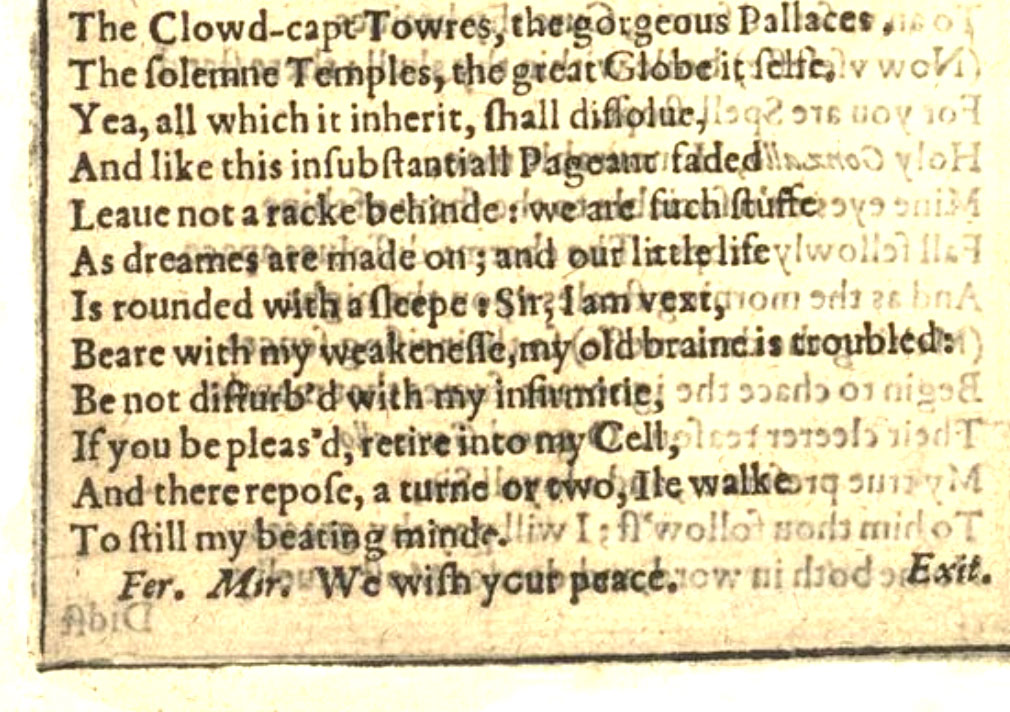
Source: The First Folio, The Tempest, Act 4 Scene 1 as printed in 1623
Coventina
(29,752 posts)Otherwise you are just making stuff up.
GreatGazoo
(4,634 posts)https://theblackandwhite.net/70984/opinion/to-teach-shakespeare-or-not-to-teach-shakespeare-that-is-the-question/
Everything we read and hear influences our sense of what is grammatical and therefore how we approach grammar:
There’s some truth here: we need that “grand synthesis” in order to use English effectively. I’m using it to write this article. But all of us built that “grand synthesis” ourselves in early childhood. By the time we entered first grade, most of us knew how to use the elements of grammar in an amazing variety of ways.
Harvard professor Steven Pinker explains that “The complexity of language, from the scientist’s point of view, is part of our biological birthright; it is not something that parents teach their children or something that must be elaborated in school”
https://medium.com/@jeanreynolds40/the-case-of-the-missing-grammar-e1f326178630
Coventina
(29,752 posts)The first one is written by a high-schooler as an opinion piece.
That's just laughable as a source to discuss the scholarly merits of studying Shakespeare.
The second one doesn't address the subject of whether Shakespeare should be studied or not.
It just talks about the history of English grammar.
A-Schwarzenegger
(15,818 posts)the utter beauty of that line?
GreatGazoo
(4,634 posts)But the grammar always bugged me which is why I looked for answers about why it was never corrected.
Is the line less impactful if corrected to:
"We are such stuff as dreams are made of and our little lives are rounded with a sleep." ?
A-Schwarzenegger
(15,818 posts)They are the conscious choices of the artist,
as is your focus on grammar when the line
calls to your soul.
GreatGazoo
(4,634 posts)was printed. IOW they did not sign off on the printed text.
In the 1623 printing the quote is printed as:
Leave not a racke behinde: we are such stuffe
As dreames are made on; and our little life
Is rounded with a sleepe: Sir, I am vext,
So modifications to spellings and punctuation have been made in subsequent printings but "on" for "of" remains as does lack of agreement between "we" and "life"

snot
(11,818 posts)what are your two grammatical errors? (I don't see them.)
That said, dictionaries weren't invented until around Shakespeare's time, let alone grammar as it's taught now.
Also: the main purpose of grammar and diction is to enhance clarity; they are extremely valuable to know, but great authors's knowledge of those rules enable them to break them at will in ways that render their writing all the more meaningful.
GreatGazoo
(4,634 posts)"We" starts the line but the singular "life is" ends it. The corrected version is:
"We are such stuff as dreams are made of and our little lives are rounded with a sleep."

FSogol
(47,626 posts)Or anything else. I feel sorry for you.
A-Schwarzenegger
(15,818 posts)summed it up.
Or, up you summed it.
MorbidButterflyTat
(4,527 posts)Up it you summed?
Sorry.
A-Schwarzenegger
(15,818 posts)the horrors bad grammar of.
(I'm getting dizzy, a major symptom of it.)

Xavier Breath
(6,644 posts)
GreatGazoo
(4,634 posts)I dare do all that may become a man;
Who dares do more is none.
LADY MACBETH What beast was't, then,
That made you break this enterprise to me?
When you durst do it, then you were a man;
And, to be more than what you were, you would
Be so much more the man. Nor time nor place
Did then adhere, and yet you would make both:
They have made themselves, and that their fitness now
Does unmake you.
No. And yet we should force it on high school students? Ben Jonson (1572-1637), editor of the First Folio, complained that it was incomprehensible so what chance do modern high school students have with it.
Ocelot II
(130,572 posts)if they hadn't already been dumbed down by social media with shallow content that didn't require more than five minutes' study. I read Shakespeare in high school and loved it. I read plays that weren't even required reading because the language was so wonderful. It's like saying why listen to Bach, that music is so complicated and boring, when you can have all the Taylor Swift and Justin Bieber songs piped right into your head on demand?
GreatGazoo
(4,634 posts)But this is incomprehensible as Ben Jonson noted 403 years ago:
And, to be more than what you were, you would
Be so much more the man. Nor time nor place
Did then adhere, and yet you would make both:
They have made themselves, and that their fitness now
Does unmake you.
snot
(11,818 posts)"I dare do all that may become a man"
- Uses "become" in two senses: that of actually becoming a manly man, and the other in the sense of, that outfit is becoming on you; i.e., the brave soldier Macbeth has shown the courage to do everything that a manly man should do – remember, he just came from a battle in which he valiantly defeated rebels against the good King Duncan.
"who dares do more is none"
- i.e., anyone man who does more, i.e. by committing the kind of violence urged by Lady Macbeth, not in service of a good leader but to murder him – is not a man but something else – a predatory beast, or one who is betraying and abjuring his "higher" nature as a human being.
"What beast was it then, that made you break this enterprise to me?"
– This turning of Macbeth's implication against him back-handedly underlines the idea that murdering Duncan would be beastly and also confirms that Macbeth had previously discussed with Lady M. his ambitions to become king with Lady M., even via murder. But since Duncan just that day had rewarded Macbeth's valor by awarding him the title of the lead traitor whom Macbeth had defeated, Macbeth is now feeling like he might not need to murder anyone in order to advance his career (as he mused before Lady M.'s entrance, "If chance will have be king, then chance may crown me without my stir" ; plus at this point in the play, he hasn't fully suppressed his humanity – that comes later (at which point for him, life has become "full of sound and fury, signifying nothing" – because through the Macbeths' own actions, they have robbed their lives of everything that most humans experience as most meaningful).
"When you durst do it, then you were a man;
And, to be more than what you were, you would
Be so much more the man. Nor time nor place
Did then adhere, and yet you would make both:
They have made themselves, and that their fitness now
Does unmake you."
- Lady M.'s words confirm that they had in fact previously discussed the possibility of murdering Duncan and Macbeth had spoken as if he were ready and willing, but now, since Duncan's decided to overnight in the Macbeths' castle (and who knows when that might happen again), the perfect opportunity has presented itself without Macbeth's having to make it – the time and place have made themselves, and they are here and now – but she's telling him that his courage and will have evaporated and in her eyes and he's in danger of unmaking himself as a manly man.
Note, earlier in the same scene, Lady M. had said:
"From this time/ Such I account thy love. Art thou afeard/ To be the same in thine own act and valour/ As thou art in desire?"
- Lady M.'s basically saying she'll consider him a dickless wonder if he doesn't kill Duncan that night.
A number of the words and images presented in these lines tie directly and importantly to other passages and ideas in the play – e.g., about identity and how it is manifested, what it means to be a man, How Lady M.'s own political ambitions have little scope in her society other than via the use of her sex in order to make Macbeth her vehicle, what constitutes real generativity, etc.
wcmagumba
(6,212 posts)both were very enjoyable to me...

3catwoman3
(29,431 posts)Silas Marner - boring
The Mill on the Floss - boring
Great Expectations - AGONIZINGLY BORING
Coventina
(29,752 posts)I hated everything I ever read by them.
Ilikepurple
(687 posts)Maybe it had to do with my developmental stage at the time, but I found most of them, even the shorter ones, to be a slog. There were exceptions of course, but relatively few. It might just be a coincidence that the 19th century might be when Shakespeare’s influence on English literature was strongest. Not all of us can or need to be Shakespeare. In any case, the density of Shakespeare’s works provided a more interesting language game to me than many 19th century novels. I found the European and Russian novels from that time period spoke to my intellectual curiosity a bit more directly.
Coventina
(29,752 posts)So they purposely tried to be as wordy as possible.
Jilly_in_VA
(14,394 posts)"A Tale of Two Cities" was and is still a really good story, I don't care how old you are. My mother told, years later, about a conversation she overheard between my younger (by 4 years) brother and his friends discussing that book. They were having a really animated discussion about how exciting and interesting it was.
I think the problem with a lot of 19th century novels (Dickens especially) is that they are designed to be read aloud. In such case, audiobooks are not a bad thing and kids might be allowed to absorb them that way. I will definitely agree with you about George Eliot, though I found the dramatizations of some of her books enjoyable. I finally got into "The Brothers Karamazov" in audiobook format although many of my friends read it in print in high school and affectionately referred to it as "The Brothers K". Meanwhile I was reading "Kristin Lavransdatter" in the awful 1920s translation and loving it I recently reread it in the modern translation and liked it a whole lot better. Oh, and I still don't like Jane Austen, so sue me.
Ilikepurple
(687 posts)I believe you may be right about being more engaging when read aloud. I might have just been impatient, but I did like Dostoevsky, but I don’t know if my patience came from reading Notes From Underground and Turgenev’s Fathers and Sons first. I think it warmed me up to Russian literature of the era by being short and odd enough for my attention span. I know you don’t have to take sides, but Notes From Underground gave me more patience with Dostoevsky than Tolstoy. I should try Anna Karenina another try in audio form. I understand Austen and the Brontés sisters literary importance, but have not revisited them or Hardy, Conrad, Hawthorne, Melville, and others I’m sure. I have not read Kristin Lavransdatter, but your reply piqued my interest. I do like literature and recognize the 50 year old biases should be revisited, but there are so many novels I know I still want to read.

JoseBalow
(9,500 posts)That's much more my glass of tea. 

OldBaldy1701E
(11,176 posts)And, just as it is not a good idea to ignore the past the it comes to politics, science, or medicine, it is not a good idea to ignore the literature and artistic methodologies that created the literature and methods we use today.
Try reading some science fiction if you would like to learn about what can happen to civilizations that forget their histories and/or mythologies.
It never ends well for them. Ever.
Of course, I had read most of the main plays by the time I was twelve. I love Shakespeare.
(English nerd here.).

NNadir
(38,088 posts)That strikes me as relevant to every core of my being.

Torchlight
(6,833 posts)Goode Lucke!
Iggo
(49,934 posts)snot
(11,818 posts)thanks for the opportunity to make the contrary case.
5. Yes, the language is archaic, and yes it takes some work to get through the first 2 or 3 plays; so I'd certainly agree that it should not be taught until the latest grade levels (or perhaps the earliest, while kids are still adroit at picking up languages). But...
4. The subject-matter could not be more relevant. First, yes, Shakespeare makes fun of lower-class people; he also makes plenty of fun of upper-class people; ditto villains vs. heros. Second, I simply do not know of any author that has managed to cram so much wisdom about so many subjects into so few words – he is brilliant about politics, social relationships, marriage, individual psychology, ethics, epistemology, language, etc. etc. – which is why his plays have been produced more often than those of any other author ever and continue to be produced to this day (see, e.g., Aneil Karia's new version of Hamlet). A great many of the world's greatest directors have made versions of one of the plays, even though they might seem outside the director's usual range (see, e.g., Joel Coen's production of Macbeth, in which Frances McDortmund contributes one of my favorite Lady Macbeth performances, or Akira Kurasawa's Throne of Blood, also ased on Macbeth). (And yes, our mores in some areas have changed since Shakespeare wrote about them; but Shakespeare's treatment of those areas was vastly more enlightened than typical in his day.)
On top of all that, the language he used was among the most exquisite and inventive of any author ever – substantial chunks of our modern words and phrases were literally invented by Shakespeare.
3. There are tons of bad productions of Shakespeare, in which actors proclaim the lines relatively tonelessly because they haven't gone to the trouble to fully understand and bring out the meanings embedded within them – this, to my mind, is a tragedy, because it does turn people off to the Bard. And yes, much of Shakespeare's work is stylized, but much of it is brilliantly naturalistic; plus, I don't see how you can complain in one paragraph that it's stylized and complain in another that there's not more music, like a hollywood musical, which is about as stylized as you can get.
As for the length, I think an argument could be made that we'd be better off viewing full productions of Hamlet than feeding our ever-shorter attention spans with TikTok & the like; also, Hamlet is a good deal longer than any of the other plays.
2. I'm fine with the plays not being operas or musicals. As far as I know, no one knows what melodies might have been used in the early productions for the songs found in the plays or as background music between the actual songs. Every production I've seen adds whatever music the director thought helpful for both the songs and otherwise, just as does nearly every film made since film was invented.
1. Yes, there's tons of other great literature for people to read – thankfully! (And I certainly concur in the importance of expanding curriculae beyond the Western canon.) But nearly every great work of Western literature or film that I've encountered contains one or more references to Shakespeare's works, and those references aren't thrown in just for fun; they are included because they carry with them a whole universe of truth and meaning that Shakespeare created for us. If you want to understand great, more modern literature, it's helpful to have some familiarity with Shakespeare.
PS: In response to some of the replies above, I'd just like to add that ihmo, if you take any set of lines from any one Shakespearean character as the whole truth about either the world or what the Bard himself believe, you're missing at least one important aspect of his worldview.
If you should be interested in trying to give Shakespeare another chance, you might possibly appreciate this miniature Shakespeare Festival for Book Clubs – http://www.c-cyte.com/shakefest/shakefest.pdf – which is basically a set of favorite, often famous scenes from the plays, formatted so that all the archaic language is clearlly explained directlly across from the line in which it occurs (so you don't have to keep moving your eyes to fine print at the bottom of the page – makes it a lot easier to get through the archaic bits). The script also provides brief synopses to be read before each scene is enacted, to set the stage plot-wise and also give clues to some of the important themes. This ShakeFest was designed specifically for amateurs – no memorization required; you can just print your pages and read out the lines – and has been the basis of many great parties in which the guess were encouraged to choose a part or the type of part they were interested in and then use their creativity in performing it; e.g., I've seen Macbeth enacted by a cat, and the intense scene in which Hamlet excoriates his mother performed with sock puppets.
GreatGazoo
(4,634 posts)I'm okay with Shakespeare on the page. Not looking for a 5-hour Hamlet performance.
My main point was that it should not be required. For AP fine but for ESL and students who struggle with modern English it seems a disservice to force them to learn grammar and phrasings that are no longer used or considered correct.
It is now frequent topic of debate in education circles:
https://www.edweek.org/leadership/opinion-why-im-rethinking-teaching-shakespeare-in-my-english-classroom/2019/10

mwmisses4289
(4,211 posts)As for "The Crucible" - it is good play, although Arthur Miller did play fast and loose with the history in order to tell his story.
Jilly_in_VA
(14,394 posts)I quit the drama club at my small college when the faculty advisor wanted to cast me as Emily because I looked so young. I hated that play so much. OTOH, I love "The Crucible"< in part because I've seen it a couple of times, once on TV and once live with the Madison (WI) Theatre Guild in which Al Strobel (who later playedf the one Armed Man in "Twin Peaks" played Deputy Governor Danforth and scared the socks off of half the audience. He had the deepest, scariest voice!

Aristus
(72,206 posts)I read the replies. It looks sincere. And I disagree.
I will admit Shakespeare is often taught in the wrong way, and can be confusing to young kids. I say save the literary study for later, and let kids be entertained by it. I had sincere, deeply devoted teachers unintentionally making Shakespeare painfully boring because they thought it was supposed to be studied instead of enjoyed.
Then a bunch of us rambunctious kids from English class had an opportunity to see “The Merry Wives Of Windsor” at the Seattle Rep. No lectures, no subtitles or footnotes, no study. And we loved it! We laughed uncontrollably the whole way through. Sure, some of the language we didn’t quite get. But skilled actors performing naturalistically make Shakespeare comprehensible to the layman. It was a wonderful introduction to Shakespeare as it was meant to be experienced.
The same thing happened a few years later when, on the suggestion of a fellow soldier, a bunch of dumb-ass tankers sat down to watch Kenneth Branagh’s “Henry V”. Just like the kids above, we were entranced by the film, and had no trouble understanding what was going on. The fact that it was about war certainly kept our attention.
So, I don’t agree. Not only should we teach kids Shakespeare, I think the earlier we start, the better. Teachers have suggested fourth grade as a starting point; kids that age are already learning new words all the time; adding Tudor English won’t even be a speed bump.

Zorro
(18,699 posts)I seriously doubt there's any contemporary playwright who will be so remembered.
And I've really never heard of a school that "requires" students to read Shakespeare.
Jilly_in_VA
(14,394 posts)We read at least one Shakespeare play every year. Freshman year, depending on what English class you were in (I think there were't enough books to go around, or something) it was either "Romeo and Juliet" or "Midsummer Night's Dream". My class got the latter, and I still giggle at the memory of some of my classmates doing the Pyramis and Thisbe bit and one of them playing the wall. Sophomore year was "Julius Caesar" during which a certain quiet classmate surprised all of us with his amazing reading of Brutus' speech. Junior year it was "Macbeth" and we had a glorious time with that as my class's English teacher had been a drama major. Senior year was "Hamlet" and that would hae been fun had our teacher not been completely incompetent. She had a nervous breakdown between semesters and we got a really cool one for second semester who would have made the play quite interesting.
Zorro
(18,699 posts)I didn't really encounter Shakespeare until I took two semesters of a course in college.
It is one thing to just "read" Shakespeare, but to hear and watch the plays -- it's transformational.
Back in the day I went to "Shakespeare in the Park" summer productions in both NYC and Louisville and they were both quite entertaining and enjoyable.
Jilly_in_VA
(14,394 posts)This was in the late 1950s to early 1960s and although it was in a college town, not all the kids in that town went to college or were fdrom faculty families by any means. It was standard in the curriculum across all the high schools, and the other two were very blue collar.

DBoon
(24,998 posts)Last time I looked Games of Thrones dealt with archaic subject matter and medieval political plots, yet managed to be very popular
ABC123Easy
(286 posts)Couldn't be more in disagreement with you on all of your points. This sounds like something a red state educated person would say, rather than someone with a decent education. I'm not claiming anything there, notice I said, "sounds like". That means coming from anyone, not just yourself....I'd get the impression whoever said it was not educated and has the attention span of a fly......ie.....a red state education.
I can't think of a single written work by Willie Shakes that's not better than any of those works you listed either.
Just my two cents.

walkingman
(10,877 posts)I think most of the time the difficulty lies with the way it is taught, basically the teacher. I think it plays an important role in education because it forces student to do something that is critical to learning......it teaches you to THINK. Sometimes I think that is not stressed enough.