How steep is Trump's democratic backsliding? The most rapid in contemporary history
If there's anyone I trust to construct meaningful measures of this, it is John Burn-Murdoch of the Financial TImes. His analysis of the pandemic was second to none. Paul Krugman links to this, and endorses it.
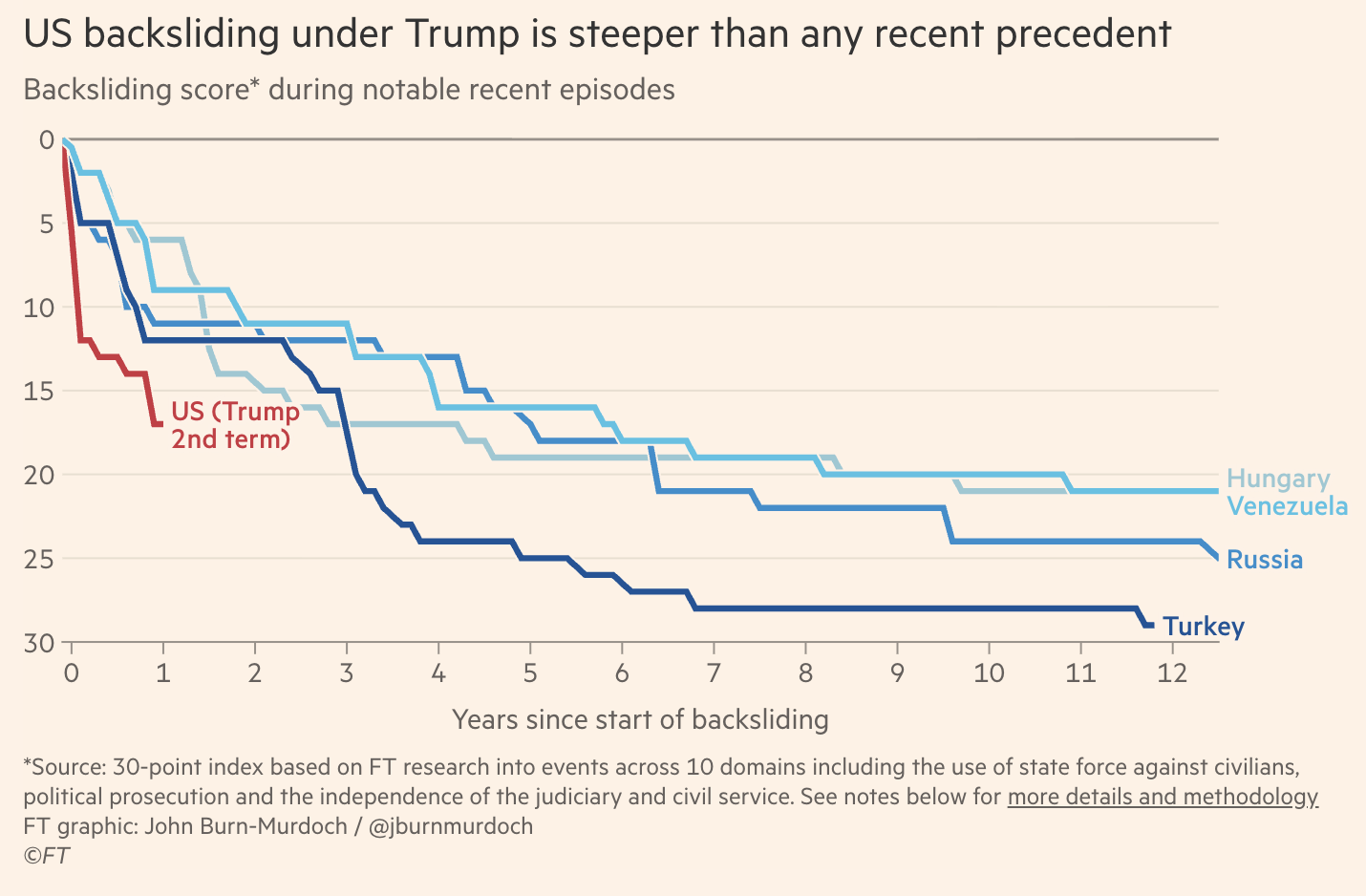
Measured using objective criteria spanning 10 domains including the use of state force against civilians, political prosecution and the independence of the judiciary and civil service, I find that the US slide during Trump’s second term stands out as the most rapid in contemporary history. It outpaces the early stages of backsliding under Russia’s Vladimir Putin, Turkey’s Recep Tayyip Erdoğan and Hungary’s Viktor Orbán, where similar steps unfolded over several years.
...
To answer this it is useful to explore how the different backsliding episodes have taken place. Specifically, have they been characterised primarily by one-time unilateral executive actions and shows of force, or durable changes to policy and legislation facilitated by weak or co-opted institutions?
And here, a difference emerges. In the cases of Russia, Turkey, Hungary and Venezuela, erosion came about through both channels. The likes of Putin, Erdoğan, Orbán and Hugo Chávez were able to consolidate power by exerting considerable control over the courts, media and electoral and political systems in addition to direct executive actions, locking in durably favourable conditions for themselves and hostile environments for their opponents. In Trump’s second term, by contrast, most of the action has taken the form of shocking acts or events that bypass rather than permanently corrupt institutions.
This is not in any way to downplay the corruption, brutality or casual disregard for the law that has characterised US government during Trump’s second term in office, nor to gloss over the abdication by the US Congress of its responsibility to prevent presidential over-reach. Rather, it is to note a glimmer of hope for the US in the fact that many of its institutions and processes appear far more resistant to takeover than those that have crumbled underfoot elsewhere.
https://www.ft.com/content/b474855e-66b0-4e6e-9b73-7e252bd88938(or archive link:
https://archive.ph/iKdQn )
Krugman's substack:
American Democracy Will Not Die in Darkness
The startling extremism of the Trump regime, even compared with other modern wannabe dictatorships, is obvious to the naked eye. But I always find quantification useful. So I was very pleased to see that the estimable John Burn-Murdoch of the Financial Times has risen to the occasion, producing an index of democratic backsliding that lets us compare the trajectory of the United States under Trump with those of other nations we used to view as cautionary tales. (I’ve looked at how the index is constructed, and it’s reasonable.) We’re on a uniquely steep descent, at least for modern times:
 https://substack.com/home/post/p-186722851
