Welcome to DU!
The truly grassroots left-of-center political community where regular people, not algorithms, drive the discussions and set the standards.
Join the community:
Create a free account
Support DU (and get rid of ads!):
Become a Star Member
Latest Breaking News
Editorials & Other Articles
General Discussion
The DU Lounge
All Forums
Issue Forums
Culture Forums
Alliance Forums
Region Forums
Support Forums
Help & Search
General Discussion
Related: Editorials & Other Articles, Issue Forums, Alliance Forums, Region Forums
Trump Kicks His Dismantling of Veterans' Health Care Into High Gear

His proposed new budget shrinks the VA’s ability to meet veterans’ needs.
https://prospect.org/2026/06/04/trump-kicks-dismantling-of-veterans-health-care-into-high-gear/

Secretary of Veterans Affairs Doug Collins testifies before the Senate Committee on Veterans’ Affairs, May 20, 2026, on Capitol Hill in Washington. Credit: Jose Luis Magana/AP Photo
Midway through the Senate Veterans’ Affairs Committee’s May 20 hearing on the VA’s advance budget request, Sen. Angus King (I-ME) pressed VA Secretary Doug Collins on his view of the future of veterans’ health care. Every net increase in Collins’s FY2028 advance appropriations request was earmarked for care delivered by private-sector providers. To King, the intention seemed unmistakable: a plan “to gradually privatize VA health care coverage.”
Collins’s response was withering in its contempt—for the question and the questioner alike: “There is no intention to gradually, there is no intention to accelerate, there is no intention to decelerate, there is no intention to privatize at all.” Collins also deftly erected a misleading straw man, framing “privatization” as if it means shutting down the Veterans Health Administration (VHA) totally and handing it over to the private sector. As Prospect co-editor Paul Starr explained in a seminal essay, this definition is both misleading and plain wrong, as privatization encompasses any shift of activities, functions, or production of goods from the public sector to the private—including what he calls “privatization by attrition,” in which the expansion of costlier private services starves the public ones of funding. That is precisely what’s been happening—and Collins’s proposed budget would turbocharge it further.
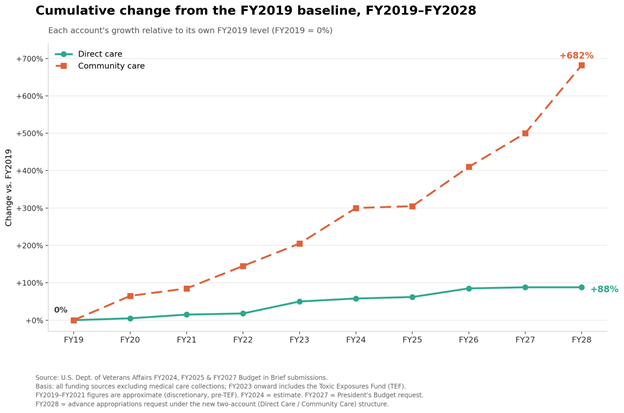
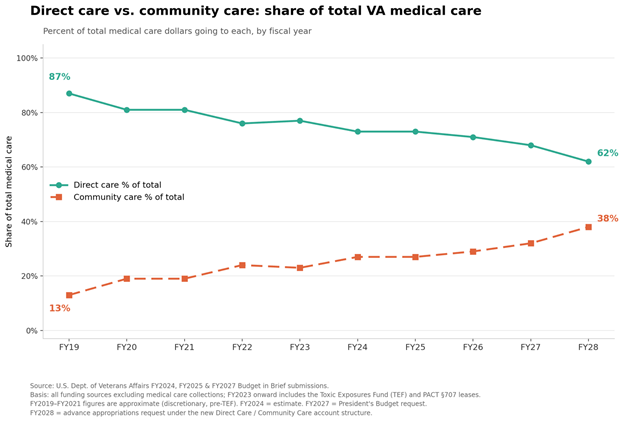
These policies are, of course, the logical extension of the dynamic set in motion a decade ago. The Veterans Choice Program opened veterans’ care to the private sector in 2015; in 2019, it was replaced and expanded by the VA MISSION Act, which mandated the creation of the Veterans Community Care Program (VCCP), a private-sector network that comprises more than 1.7 million providers, including doctors and hospitals. Spending on what has become known as “community care” has gathered momentum every year since, climbing 410 percent above its 2019 level. Over the same period, the VA’s spending on its own direct care rose just 84 percent. Rather than tap the brakes on these runaway community care costs, Collins is flooring the accelerator. By 2028, community care spending will stand at 682 percent above its 2019 level.
By contrast, as Sen. Tammy Duckworth (D-IL)—a disabled veteran and former VA assistant secretary for public and intergovernmental affairs—made clear, Collins’s request for VA in-house care, when adjusted for inflation, represents a cut in the direct care budget, which she called “an abandonment of veterans.” Duckworth also highlighted the discrepancy between Collins’s request and the projections in the Independent Budget (IB), a proposal crafted by two of the largest national veterans service organizations (VSOs): the Disabled American Veterans (DAV) and the Veterans of Foreign Wars (VFW). The IB found that a 19.4 percent increase is needed to keep the VA adequately staffed—the inverse of what Collins is proposing. Collins responded by deriding the veterans organizations’ projections, shouting at Duckworth that “outside independent agencies are not responsible for anybody. They can put down numbers in any way they want to have it.” As the two graphs below reveal, the redistribution of veterans health care spending is staggering.
snip